Featured Analysis · Discovery
Following the Evidence: Emma Mason Furniture, Alleged Cyber Espionage, and Federal Discovery
How a federal trial could confirm or disprove the alleged Emma Mason Furniture hacking scheme and Aleksandr Yampolskiy's involvement.
01The unresolved allegation
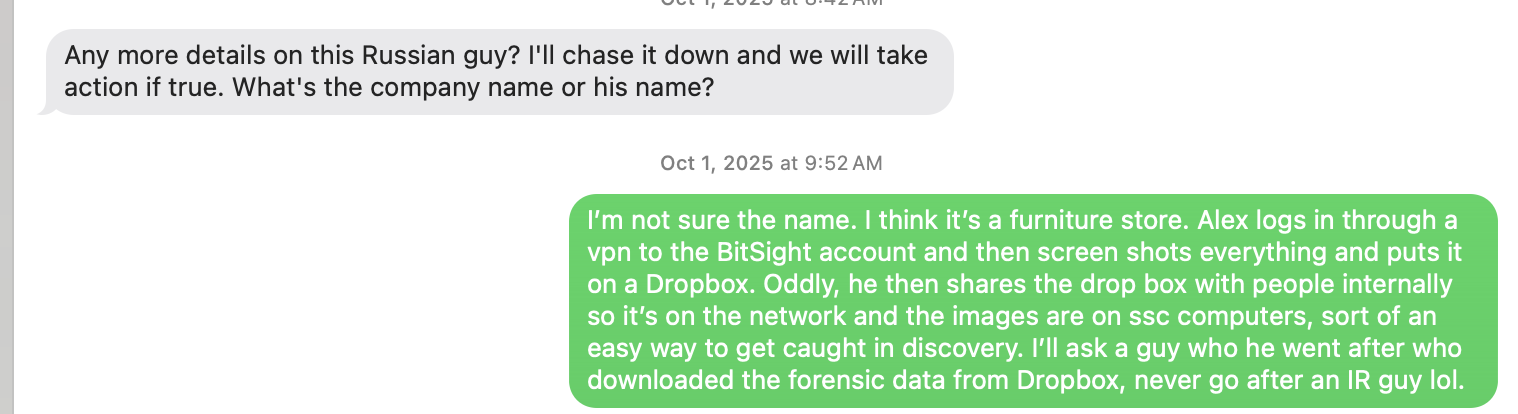
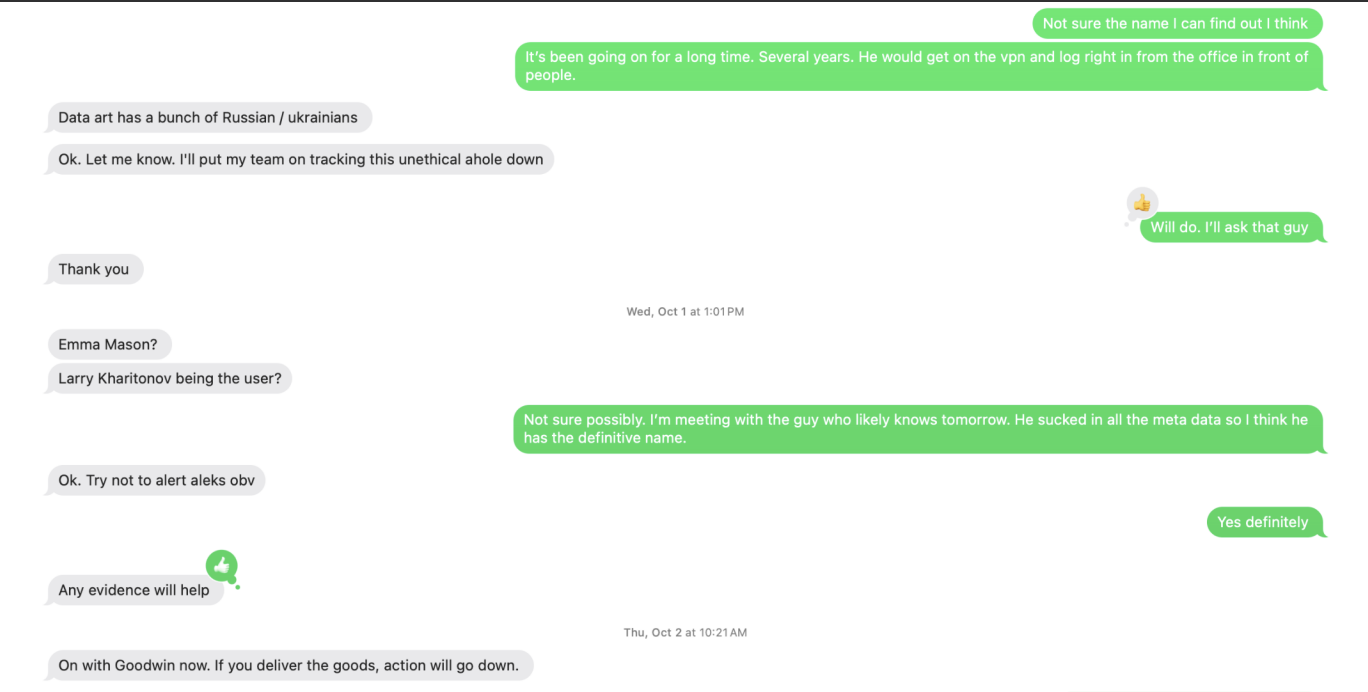
In text messages dated October 1 and 2, 2025, which appear in the evidence section of this site, Jason Thompson describes a person he calls “Alex” logging in through a VPN to a cybersecurity competitor's account, screenshotting what he saw and sharing the images through Dropbox inside SecurityScorecard. In the same exchange, the other participant asks: “Emma Mason?”
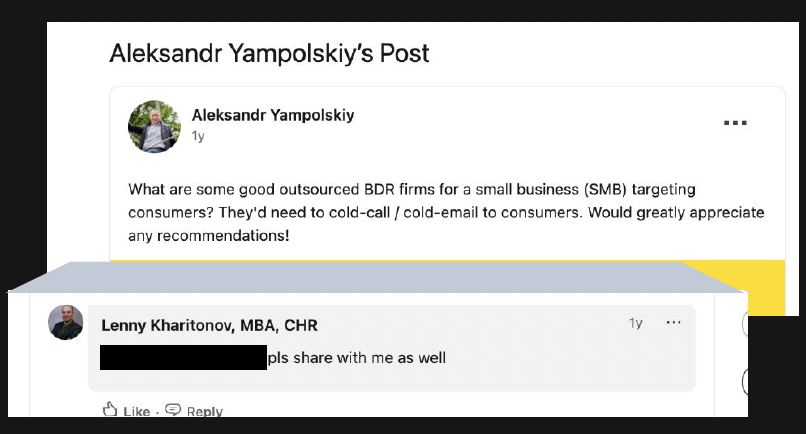
Emma Mason is a furniture business, not a person. Lenny Kharitonov's LinkedIn profile lists him as CEO of Emma Mason Furniture, and a separate screenshot shows Kharitonov commenting on a public LinkedIn post by Aleksandr Yampolskiy. According to Thompson, the competitor's incident-response (IR) team identified the “Emma Mason” account, and Kharitonov, as the account being used, and holds forensic evidence supporting that finding. That IR report has not been published. This site has not reviewed it, and the competitor has not commented publicly.
That leaves a specific question nobody can answer from the public record: who, if anyone, used an Emma Mason account to reach a competitor's systems, and did anyone at SecurityScorecard direct or receive the results? The screenshots on this site show what Thompson said and that two men interacted on LinkedIn. They do not show who used the account or that the CEO directed anything. This article sets out what the federal discovery process could test, the limits on that process, and what each possible result would mean.
One limit comes first. The current federal complaint centers on Factor's trademarks, intellectual property, defamation and tortious interference. Discovery about a separate alleged intrusion at a competitor has to be relevant to those pleaded claims and proportional to the needs of the case under Federal Rule of Civil Procedure 26(b)(1). Otherwise it would take an amended complaint or a separate proceeding. No court has ruled on this, and there is no guarantee a trial will hear it.
- 1
“Emma Mason” account alleged
Plaintiff's texts, Oct 1–2, 2025
? Did such an account exist on the competitor's platform, and who registered it?
- 2
Competitor IR logs
Alleged; not published
? Do authenticated logs record the logins, and can a custodian authenticate them?
- 3
Account & device attribution
To be tested
? Which person and which device used the credentials — not just which IP?
- 4
Alleged file transfer
Screenshots → Dropbox, alleged
? Do EDR, browser or Dropbox records show capture and upload?
- 5
Possible recipient / company nexus
To be tested
? Did files reach SecurityScorecard accounts, and who directed or received them?
- 6
Sworn testimony
Potential only
? What do the account holder, IR staff and SSC witnesses say under oath?
- 7
Court
No finding made
? Is the evidence relevant, admissible and persuasive to a fact-finder?
Solid ring: a claim that appears in the published record (as an allegation). Dashed rings: links not established by anything published. Each “?” is a question that would have to be resolved, in order, before the chain connects.
02What a competitor's incident-response investigation could prove
If a competitor's security team investigated suspicious access, the strongest evidence would not be its written conclusions. It would be the underlying records: authentication logs showing which credentials signed in, when, from which IP addresses and with what multi-factor events; session records showing which pages, reports and customer data were viewed; and administrative records showing when the account was created, by whom and with what payment or contact details.
Endpoint detection and response (EDR) telemetry and browser logs, where available, can show screenshot tools, bulk downloads or sync clients running during a session. The competitor's own platform analytics might show viewing patterns consistent with systematic capture, such as rapid page-by-page navigation through scoring methodology or customer portfolios. None of this identifies a person by itself. It identifies credentials, sessions and machines.
Collection matters as much as content. A court would ask whether logs were preserved in the ordinary course, exported by someone who can testify to the process, and kept with a documented chain of custody. IR reports prepared at a lawyer's direction may be claimed as attorney work product, which can limit what the competitor must produce, although underlying facts and business-record logs are generally not shielded the same way. The competitor is not a party to the case. Any production from it would come through a Rule 45 subpoena, which it could negotiate, narrow or move to quash.
- Emma Mason
- A furniture business. Lenny Kharitonov's LinkedIn profile lists him as CEO, Emma Mason Furniture.
- Oct 1–2, 2025 texts
- Screenshots on this site show Thompson describing “Alex” logging in via VPN, screenshotting and sharing via Dropbox; the other person asks “Emma Mason?”
- Kharitonov–Yampolskiy contact
- A public LinkedIn post by Yampolskiy with a comment from Kharitonov.
- Competitor IR report
- Nothing published. Not reviewed by this site.
- VPN / Dropbox
- Described only in the plaintiff's texts.
- Direction by the CEO
- Nothing published establishes it.
03Emma Mason Furniture and the account-control questions
The Emma Mason name raises a set of plain factual questions that records could answer. Did an account under that business name exist on the competitor's platform? Who signed up, with which email domain, phone number and payment method? Was it a trial, a paid subscription or a partner account? Who held the credentials, and were they shared?
Kharitonov's public profile establishes only that he presents himself as the company's CEO. It does not show that he opened the account, used it, knew of it or lent his company's name to anyone. Equally, a LinkedIn comment on a Yampolskiy post shows a public interaction, not a business arrangement. If the matter reached discovery, a subpoena to Emma Mason Furniture or a deposition of Kharitonov could ask about any account registration, any relationship with SecurityScorecard or its personnel, and any payments. He would be entitled to counsel, to object and to assert any applicable privilege. His answers could clear him as readily as implicate anyone.

Read as text
LinkedIn profile of Lenny Kharitonov (CEO, Emma Mason Furniture)
Evidence carousel. Screenshot provided by the plaintiff, captured October 8, 2026. Mutual connections redacted.
Lenny Kharitonov, MBA, CHR (2nd-degree connection). Headline: "Entrepreneur & Investor | CEO, Emma Mason Furniture | Angel Investor | Private Lender (Real Estate) | PIPE / Convertible Debt Investor." New York, United States. 500+ connections. Self-employed. Columbia University - Columbia Business School. Relevance per Factor: Factor alleges an "Emma Mason" account was used to gain unauthorized access to Bitsight (October 1–2, 2025 texts), and a separate LinkedIn exchange shows Mr. Kharitonov commenting on a post by Mr. Yampolskiy. According to Thompson, Bitsight's incident-response team identified the "Emma Mason" account and Mr. Kharitonov as the account being used and has forensic evidence supporting that. That forensic evidence has not been published or reviewed by this site, Bitsight has not commented publicly, he is not named in any court filing, and no court has made findings.
Read as text
LinkedIn post by Aleksandr Yampolskiy with a comment by Lenny Kharitonov
Evidence carousel. Screenshot provided by the plaintiff to show that Kharitonov and Yampolskiy are acquainted. Posted about one year before capture (shown as "1y"); exact date unconfirmed. Names of tagged third parties redacted.
Aleksandr Yampolskiy's Post (1y): "What are some good outsourced BDR firms for a small business (SMB) targeting consumers? They'd need to cold-call / cold-email to consumers. Would greatly appreciate any recommendations!" Comment by Lenny Kharitonov, MBA, CHR (1y): [tagged names redacted] "pls share with me as well." The exchange shows a public LinkedIn interaction between the two; it does not by itself show the nature of their relationship.
04The VPN and Dropbox forensic chain, and the limits of IP attribution
Thompson's messages describe a VPN. VPNs exist precisely to hide where a connection originates, so an IP address in a competitor's logs would most likely point to a VPN provider's exit server shared by many customers. To get past that, a party would need records from the VPN provider, which many providers say they do not keep, or records on the user's side: a corporate VPN gateway, a configured client on a company laptop, or network logs showing the connection leaving a specific office.
Dropbox is a more promising source because it keeps account-level audit trails: uploads, shared-folder membership, link creation and access by device. If screenshots were stored in a Dropbox shared inside SecurityScorecard, as the texts allege, the company's own Dropbox Business admin console, or a subpoena to Dropbox for account-holder records, could show who uploaded what and when. Federal law (the Stored Communications Act) generally bars providers from handing over the content of communications in response to a civil subpoena, so content would typically have to come from the account holders or the company itself.
Even a perfect match between an IP address and an office does not establish which person was at the keyboard. Attribution normally comes from combining technical records with device images, login credentials, timing and testimony. A judge or jury would weigh every link in that chain, and a single gap can break it.
Read as text
Text messages, October 1, 2025 — "Russian guy" and the Bitsight account
Evidence carousel. Provided by the plaintiff; unverified.
Text message screenshot. Incoming message (sender not shown), October 1, 2025: "Any more details on this Russian guy? I'll chase it down and we will take action if true. What's the company name or his name?" Reply from Thompson, October 1, 2025 at 9:52 AM: "I'm not sure the name. I think it's a furniture store. Alex logs in through a vpn to the BitSight account and then screen shots everything and puts it on a Dropbox. Oddly, he then shares the drop box with people internally so it's on the network and the images are on ssc computers, sort of an easy way to get caught in discovery. I'll ask a guy who he went after who downloaded the forensic data from Dropbox, never go after an IR guy lol." These are the plaintiff's statements describing alleged conduct; no court has made findings.
Read as text
Text message exchange, October 1–2, 2025
Evidence carousel. Provided by the plaintiff; not independently verified. The other participant's identity has not been confirmed by this site.
Thompson: "Not sure the name I can find out I think." / "It's been going on for a long time. Several years. He would get on the vpn and log right in from the office in front of people." Other person: "Data art has a bunch of Russian / ukrainians." / "Ok. Let me know. I'll put my team on tracking this unethical ahole down." Thompson: "Will do. I'll ask that guy." Other person: "Thank you." Wed, Oct 1, 1:01 PM — Other person: "Emma Mason?" followed by a question naming a possible user (name withheld by this site). Thompson: "Not sure possibly. I'm meeting with the guy who likely knows tomorrow. He sucked in all the meta data so I think he has the definitive name." Other person: "Ok. Try not to alert aleks obv." Thompson: "Yes definitely." Other person: "Any evidence will help." Thu, Oct 2, 10:21 AM — Other person: "On with Goodwin now. If you deliver the goods, action will go down." According to Factor, this concerns an "Emma Mason" account allegedly used to gain unauthorized access to Bitsight. These are allegations; no court has made findings.
05Communications and roles at SecurityScorecard
If intrusion discovery were permitted, the most informative records might be SecurityScorecard's own: Slack and email search results for “Emma Mason” or the competitor's name, competitive-intelligence folders, Dropbox shares, expense and procurement records for any third-party subscriptions, and device-management logs. These would show whether competitor screenshots circulated internally, who shared them, and whether anyone asked where they came from.
Roles matter. A competitive-intelligence analyst handling material from an approved trial is a different story from an executive personally logging in under another company's name. Discovery could separate those possibilities: who had the job of tracking competitors, what policies governed it, whether legal or compliance reviewed sources, and whether any concern was raised and how it was handled.
06Yampolskiy under oath: potential deposition topics
As a named defendant, Aleksandr Yampolskiy could be deposed in the case under Rule 30, subject to the court's limits on scope and duration. No deposition has been noticed or taken. If one occurred and intrusion questions were within scope, topics could include:
- Whether he has ever held, used or been given credentials to a competitor's platform, under any name.
- Whether he knows Lenny Kharitonov or Emma Mason Furniture, how, and whether either had any arrangement with SecurityScorecard.
- His use of VPNs and personal or corporate Dropbox accounts during the relevant period.
- Whether he directed, approved or learned of any collection of competitor screenshots, and from what source.
- What he did, if anything, after Thompson's allegations surfaced, including any internal investigation and document preservation.
- The basis for his public statements about Factor and Thompson that are at issue in the pleaded claims.
Deposition testimony is given under oath and can be impeached with documents. A witness may also decline to answer on privilege grounds, including the Fifth Amendment. In a civil case a fact-finder may in some circumstances be allowed to draw an adverse inference from that, but an invocation is not evidence of guilt and cannot alone establish a claim.
07Security employees, management and directors
Rule 30(b)(6). A party can notice a deposition of the company itself on described topics, such as “competitive-intelligence practices and sources, 2023–2025.” SecurityScorecard would then have to designate and prepare a witness to give the company's binding answers. This is often the most efficient way to learn how records are kept and who knows what.
Rule 45. Non-parties, including the competitor, Emma Mason Furniture, Dropbox or former employees, can be subpoenaed for documents or testimony. The issuing party must avoid undue burden, and recipients can object or move to quash. Courts frequently narrow these subpoenas.
Directors. Board members are not deposed automatically. Courts often apply an “apex” analysis to senior officials, asking whether the person has unique, first-hand knowledge that cannot be obtained from less burdensome sources such as lower-level employees or a 30(b)(6) witness. A director who received a specific report about the allegation, or approved a response, could qualify; a director who knows nothing particular generally would not. Nothing on this site indicates any director knew of the alleged conduct.
Complaint filed
Occurred · Sept 3, 2026 (signature date)
Pleads trademark, IP, defamation and tortious-interference claims.
Relevance threshold
Potential
Intrusion discovery must tie to pleaded claims, or require amendment or a separate proceeding.
Party discovery
Potential
Document requests, interrogatories, Rule 30(b)(6) notice to SSC.
Third-party subpoenas
Potential
Rule 45 subpoenas to the competitor, Dropbox, VPN providers, Emma Mason Furniture.
Depositions
Potential
Yampolskiy, security staff, IR custodians; directors only if justified.
Admissibility
Potential
Authentication, hearsay, expert reliability, privilege and motions in limine.
Trial
Potential · not guaranteed
Fact-finder decides only issues actually tried.
08Produced discovery, the filed record, admissible exhibits and findings
Four different things are easy to confuse. Produced discovery is material exchanged between parties; much of it is never filed and is often covered by a protective order that limits public use. The filed record is what appears on the court docket, such as the complaint and exhibits listed in Documents, and it consists largely of allegations. Admissible exhibits are items a judge allows a fact-finder to consider after rulings on authentication, hearsay, relevance and expert reliability. A finding is a decision by a judge or jury on a disputed fact after trial or on summary judgment.
Material moves from one category to the next only through specific rulings. A log produced in discovery may never be filed; a filed exhibit may be excluded; an admitted exhibit may be outweighed. Reporting on this case has to say which category any piece of evidence is in. Today, the Emma Mason material on this site sits outside all four: it is plaintiff-provided evidence published by a party.
09Outcomes that would corroborate, disprove or partly support the allegation
Would corroborate
Authenticated competitor logs tied to an Emma Mason account; Dropbox or device records placing matching screenshots on SecurityScorecard systems; testimony or messages showing who used the account and at whose direction.
Would partly support
Logs confirm suspicious access under the Emma Mason name, but attribution stops at a VPN or a shared device; or screenshots circulated internally with no proof of how they were obtained or who directed it.
Would disprove or undercut
No such account existed; logs show ordinary licensed use; Emma Mason Furniture has no link to the activity; the screenshots came from public or authorized sources; or the IR report does not say what Thompson describes.
A further outcome is that none of this is tested at all, because the court finds it outside the scope of the pleaded claims, the parties settle, or the competitor's records are protected. In that case the allegation would remain exactly what it is today: unresolved.
10Legal and editorial disclosure; source documents
This site is owned by Jason Thompson, a plaintiff in the case, and is not neutral ground. Every allegation in this article is attributed. No court, police agency or regulator has found that anyone accessed a competitor's systems without authorization, and no deposition, subpoena or production described above has occurred. Mr. Yampolskiy, SecurityScorecard and Mr. Kharitonov are entitled to the presumption that they have done nothing wrong, and this site would publish their responses. This is journalism and analysis, not legal advice.
- Complaint, exhibits and police reports (text) →
- The Record and evidence screenshots →
- Timeline: October 1–2, 2025 →
- Factor v. SecurityScorecard case page (factorcyber.com) →
Related investigations
Investigations · Federal investigation
FBI Launches Formal Probe into SecurityScorecard CEO Aleksandr Yampolskiy
The FBI’s Boston Cyber Task Force interviewed multiple witnesses about Yampolskiy’s alleged access to Bitsight and requested evidence tracing Bitsight material into SecurityScorecard’s product.
Opinion
DOJ Flameout and Yampolskiy’s Criminal Defense Attorney Michael Yaeger Acts Unethically, Then Complains About the Consequences
A day after his firm sent preservation letters to a Factor executive and an advisor, Yampolskiy’s defense attorney Michael Yaeger demanded that the Chronicle come down. His email identified no factual error in the articles he attached.
Opinion
Crooked Michael Margulies Used Preservation Letters to Intimidate Witnesses
On November 19, Carlton Fields attorney Michael D. Margulies emailed a Factor Cybersecurity executive and an advisor at their personal addresses. They were already represented by counsel.
Analysis · Executive accountability
From NS8 to SecurityScorecard: When Cybersecurity Executives Become the Risk
The NS8 scandal exposed fraud and whistleblower retaliation inside a company selling fraud prevention. Allegations in Factor Cybersecurity's federal lawsuit raise a different question: Who holds cybersecurity executives accountable when their own conduct is challenged?
Investigations · Legal Analysis
AleksandrYampolskiy.com: A Masterclass in Leveling the Playing Field Through Asymmetric Advantage
SecurityScorecard's CEO publicly criticized a former executive and his startup. A landmark federal appellate decision involving Jerry Falwell explains why an independent criticism website bearing his name is not unlawful merely for using it, and how modern tools let founders level the playing field.
Analysis · Computer Fraud and Abuse Act
Did Yampolskiy's Alleged Competitor Hacking Cross the Line Drawn by the Supreme Court in Van Buren?
How the Supreme Court’s landmark CFAA decision applies to alleged unauthorized competitor access described in Factor Cybersecurity v. SecurityScorecard, and why valid credentials do not necessarily establish lawful authorization.
Investigations · Litigation
Something to Hide? Yampolskiy's SecurityScorecard Settled Competitor Lawsuit Just 10 Days After Judge Ordered Competitive Intelligence Discovery
SecurityScorecard sued a competitor over alleged improper competitive intelligence gathering. But when a federal judge ordered scrutiny of SecurityScorecard's own practices, the case settled just ten days later. Coincidence, or did the discovery order change everything?
Investigation · Litigation tactics
Drug Use, Threats, and Anonymous Emails: Who Are theothermarkh@proton.me and markh1980ny@gmail.com, and Why Do They Matter to SecurityScorecard & Yampolskiy's Defense?
Two unidentified email accounts. Allegations of antisemitic statements, threats, and drug use in federal litigation involving a longtime SecurityScorecard executive. And the same outside attorney raising questions about anonymous communications in another lawsuit. Is there a recurring litigation strategy, or something more troubling happening inside SecurityScorecard?
Analysis · Litigation exposure
From Unicorn to Firesale: Why Impacted Companies Hold SecurityScorecard’s Death Warrant
If allegations of unauthorized access to competitor platforms were ever corroborated, the leverage would sit with the companies allegedly accessed. A conditional, claim-by-claim look at the civil, criminal, commercial and valuation stakes, with an interactive model.
Litigation · Evidence · Corporate Conduct
Bad Faith: Factor Offered a Code Review to Yampolskiy's Attorneys. It Was Never About IP. This Was About Bullying.
SecurityScorecard was offered multiple opportunities to resolve its concerns, including third-party forensic examination and access to Factor's application codebase. Why did a dispute that could have been investigated privately become a federal lawsuit and a public confrontation?
Analysis · Commentary on the court record
Watching for the Response: In the Heid Lawsuit, SecurityScorecard’s Hired Guns Went Scorched Earth
A former executive alleged his name and altered likeness were used to sell AI products, and that his equity was threatened when he objected. SecurityScorecard answered with two contract counterclaims and a set of personal allegations. One case, read closely, through both filings.
Board Spotlight · Governance
Richard Seewald Promised Billions. The Record Shows a Revolving Door, a 70% Markdown and a Fight SecurityScorecard Didn’t Need
An investor’s thirteen-year bet, a billion-dollar projection, a secondary-market markdown, and the governance test confronting Evolution Equity Partners.
Investigation · Evidence
The Smoking Gun: What Evidence Would Determine If Yampolskiy Hacked Competitors, and Does Factor Have It?
A Slack message, a Dropbox link, an access log, an invoice. What the federal record already holds on alleged competitor access, what discovery would have to establish, and why each link in the chain must stand on its own.
Featured Analysis · Counsel
Yampolskiy Hires White Collar Criminal Defense Attorney. What Does It Signal, and What Is Pro Hac Vice?
October 5 court filing identifies Michael L. Yaeger among three Carlton Fields attorneys representing SecurityScorecard and Aleksandr Yampolskiy.
Analysis · Corporate governance
SecurityScorecard’s Board Was Warned. Could Shareholders Sue Under Caremark?
How Delaware’s Caremark doctrine could expose longtime directors to liability if they ignored warnings of alleged executive misconduct.
Analysis · Delaware law
Delaware Stalking and Harassment Laws: Did Repeated Communications Targeting Jason Thompson Cross the Legal Threshold?
What 11 Del. C. §§ 1311 and 1312 actually require, which communications are documented, which are only alleged, and what investigators would need to establish.