Investigations · Federal investigation
FBI Launches Formal Probe into SecurityScorecard CEO Aleksandr Yampolskiy
On November 16, the FBI’s Boston Cyber Task Force interviewed a witness who said he had watched SecurityScorecard CEO Aleksandr Yampolskiy log in to Bitsight from SecurityScorecard’s office. The supervising agent said he had already spoken with Bitsight’s general counsel and the FBI’s New York office. He asked for a side-by-side comparison showing where material allegedly taken from Bitsight appeared in the product SecurityScorecard sold.
That request marks a major escalation in the inquiry. Federal investigators are now examining two distinct questions: how Yampolskiy allegedly gained access to a competitor’s platform, and whether SecurityScorecard used what he obtained for commercial gain. The Boston agent said he would send the material to the financial fraud squad, which handles intellectual property theft. The referral also raises allegations of bank fraud, wire fraud and improper efforts to influence public contracts.
01The 6:57 p.m. message
On March 20, 2025, Yampolskiy posted a Google Docs link in a four-person Slack conversation. The thread included SecurityScorecard’s chief product officer, Adam Bixler, product manager Charles Kim, and director of competitive intelligence Christian Karwatske. At 6:57 p.m., the CEO told them:
“I got some Safari pictures 2025 of my Africa trip - to share with you. Check it out - please don't share with others though. But might be useful.”
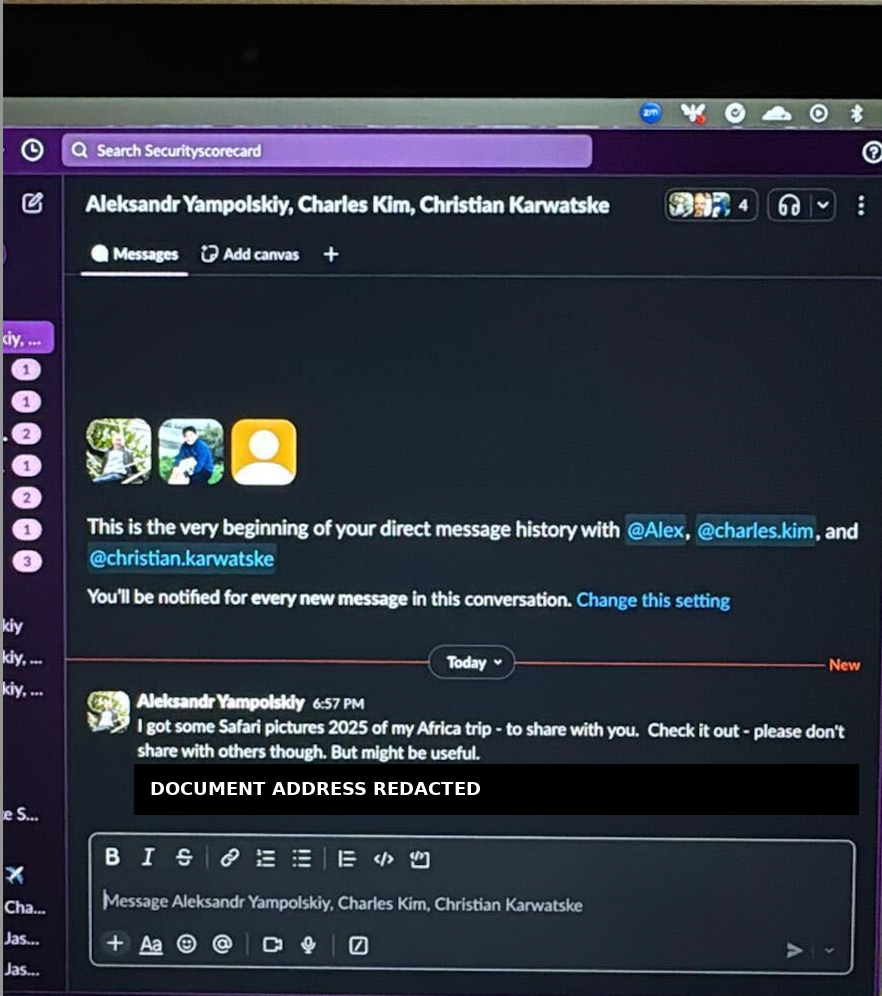
The witness account accompanying the exhibit identifies the material behind the link as nonpublic Bitsight screenshots. It also attributes a reaction to Bixler: “is this a trap”. The image preserves Yampolskiy’s words and the link. The identification of the linked material and Bixler’s reaction come from the witness account.
The recipients matter. The CEO sent what he called vacation pictures to the people responsible for deciding what to build and tracking what competitors were building. He asked them to limit circulation and told them the material might be useful. A former product executive told the FBI that Yampolskiy repeatedly redirected development after examining features inside Bitsight. The exhibit gives investigators a specific document, a time of transmission and three recipients who can describe what they received.
02The account Bitsight disabled
A witness told the FBI that he personally watched Yampolskiy activate a VPN at SecurityScorecard’s office and log in to Bitsight. Identifying the subscription took longer. In an October 1, 2025 exchange, the witness described screenshots copied to Dropbox and shared inside SecurityScorecard. One identifying detail was a furniture business. A Bitsight executive asked, “Emma Mason?”
According to the account given to the FBI, the furniture retailer’s subscription kept renewing. The account showed rotating VPN connections and little of the ordinary work a customer would perform. Bitsight disabled the account in October 2025. According to the referral, a SecurityScorecard executive then told the witness that Yampolskiy had lost access. A July 13, 2026 communication to Bitsight’s legal team identified the account and described how the data had allegedly been used.
The commercial allegation goes beyond copying a feature. The FBI was told that, during competitive sales, Bitsight data was loaded into SecurityScorecard’s platform. If that account is accurate, a buyer comparing the two vendors could have been looking at Bitsight’s work in both demonstrations.
03The earlier documentary record
The witness dated the practice to at least 2017. A January 26, 2019 email to counsel records a former executive’s account that Yampolskiy hired a hacker and instructed him to create false identities to gain access to competitors. The executive wrote that he refused. In separate messages to a Factor advisor about competitor screenshots, he identified their source in four words: “Alex sent it to me.”
Another exchange preserves instructions attributed to Yampolskiy about sending someone from outside SecurityScorecard to a Bitsight conference. “I very much want someone to attend get intelligence,” he wrote. After Bill Hogan, SecurityScorecard’s former chief revenue officer and a friend of Evolution Equity Partners, offered to send someone, Yampolskiy added, “Tell him to use his own personal credit card”. The purpose and the payment instruction appear in the same exchange.
04What Yampolskiy knew
On October 5, six weeks before the FBI briefing, Yampolskiy and SecurityScorecard asked the Delaware federal court to admit Michael L. Yaeger to represent them both in their civil case. The court granted the motion that day. Yaeger had helped coordinate federal computer-hacking and intellectual-property prosecutions in the Eastern District of New York. His colleagues on the defense team already covered intellectual property and commercial litigation. The Chronicle’s assessment is that adding Yaeger signaled that Yampolskiy recognized the risk of a criminal investigation into the alleged access.
The evidence of knowing concealment comes from Yampolskiy’s own instructions. For the Bitsight conference, he wanted an outsider to attend on SecurityScorecard’s behalf and use a personal credit card. On Slack, he called a document “Safari pictures” and asked product staff to keep it to themselves. If the witness correctly identified that document as nonpublic Bitsight material, the inference is straightforward: Yampolskiy knew what he was distributing and deliberately disguised it. Investigators can test that account against the linked document, its sharing history and the recipients’ testimony.
05The bookings executives questioned
In June 2025 messages included with the referral, executives questioned the substance of reseller bookings. On June 26, an SSC executive responded to a purported Carahsoft purchase order with “Bullshit” and “No way”. In another exchange about what the customer would actually buy, an executive asked, “So it's a fake deal”. A further message questioned the effect of pulling revenue forward from later quarters.
The bank- and wire-fraud allegation turns on what reached the lenders. The referral alleges that management counted partner orders as recurring revenue without an identified end customer, then used the reported growth to show compliance with lending terms. If convicted of federal bank or wire fraud, Yampolskiy could face more than a decade in prison. The federal bank-fraud statute carries a maximum of 30 years. The ordinary statutory maximum for federal wire fraud is 20 years.
The referral names Richard Seewald, a SecurityScorecard director and founder of Evolution Equity Partners. It alleges that he knew about competitor access and disputed revenue reporting through board complaints and financial reports, supported continuation of the practices, and blocked efforts to remove Yampolskiy after complaints reached directors.
06The public-contracting allegations
The referral names Sachin Bansal, SecurityScorecard’s former president and general counsel, in connection with alleged efforts to influence public contracting through improper payments or benefits. The witness account identifies numerous SecurityScorecard executives as witnesses to the alleged solicitation.
07What enterprise customers can ask
Which sources supplied the data in the reports customers purchased? What rights did SecurityScorecard have to use those sources? Did Bitsight material enter any product or rating used to evaluate a supplier? Customers can request written answers and the records supporting them.
For customers considering an exit, the signed agreement sets the terms. A termination-for-convenience clause may permit an exit before renewal. The notice deadline, delivery method and fees determine how to exercise it. Where nonrenewal is the available route, customers can give notice before the window closes, export historical reports, replace ratings feeds and revoke integration credentials at exit.
Many customers will be required to cancel or non-renew contracts based on the severity of SecurityScorecard's conduct and the relevant vendor conduct standards enforced by most Fortune 500 companies.