Analysis · Delaware law
Delaware Stalking and Harassment Laws: Did Repeated Communications Targeting Jason Thompson Cross the Legal Threshold?
What 11 Del. C. §§ 1311 and 1312 actually require, which communications are documented, which are only alleged, and what investigators would need to establish.
The federal complaint describes what it calls “a coordinated stalking, intimidation, and tortious-interference campaign” (Complaint ¶ 38). That phrase is an allegation in a civil pleading. Whether any of the conduct described would meet Delaware's criminal definitions is a separate question, decided, if ever, by police, a prosecutor and a court. This article tests the published record against the statutory text.
01What the statutes actually require
The official text is published by the State of Delaware at delcode.delaware.gov, Title 11, Chapter 5, Subchapter VII. Under 11 Del. C. § 1312(a), a person is guilty of stalking when the person:
“knowingly engages in a course of conduct directed at a specific person and that conduct would cause a reasonable person to: (1) Fear physical injury to himself or herself or that of another person; or (2) Suffer other significant mental anguish or distress that may, but does not necessarily, require medical or other professional treatment or counseling.”
Section 1312(e)(1) defines “course of conduct” as:
“3 or more separate incidents, including, but not limited to, acts in which the person directly, indirectly, or through third parties, by any action, method, device, or means, follows, monitors, observes, surveys, threatens, or communicates to or about another, or interferes with, jeopardizes, damages, or disrupts another’s daily activities, property, employment, business, career, education, or medical care.”
Three points follow from the text. First, three incidents are a minimum, not proof: the count establishes only that a “course of conduct” may exist. Second, the mental state is knowingly engaging in that conduct; § 1312(h) says it is not a defense that the person “did not intend to cause the victim fear or other emotional distress.” Third, the effect is judged objectively, by “a reasonable person in the victim’s circumstances” (§ 1312(e)(2)). Basic stalking is a class G felony (§ 1312(b)); aggravating factors in § 1312(c)–(d) raise the grade.
11 Del. C. § 1311, harassment, is a class A misdemeanor. It requires “intent to harass, annoy or alarm another person,” plus one of several forms of conduct, including communicating “by … any other form of written or electronic communication in a manner which the person knows is likely to cause annoyance or alarm” (§ 1311(a)(2)). Section 1311 has no numerical threshold; a single communication can qualify in principle, and many communications do not qualify if the intent is absent.
These definitions sit alongside constitutional limits. Criticism of a business, warnings about anticipated litigation, and statements of opinion are often protected speech, and communications made to pursue or prepare legal claims ordinarily have a legitimate purpose. Defamation is a civil wrong that the complaint pleads separately; a false statement is not, by that fact alone, criminal stalking.
- 1
Are there 3+ separate incidents attributable to the same person?
§ 1312(e)(1)
If no → Not stalking. Consider § 1311 (no numeric minimum).
If yes → next question
- 2
Is the conduct directed at a specific person (here, Thompson), directly, indirectly or through third parties?
§ 1312(a), (e)(1)
If no → Not stalking of Thompson; may concern Factor or the recipients.
If yes → next question
- 3
Did the person engage in the course of conduct knowingly?
§ 1312(a), (h)
If no → Element fails. Note: intent to cause fear is not required, § 1312(h).
If yes → next question
- 4
Would it cause a reasonable person in Thompson's circumstances to fear physical injury or suffer significant mental anguish or distress?
§ 1312(a)(1)–(2), (e)(2)
If no → Element fails. Business harm alone does not satisfy this.
If yes → next question
- 5
Is the speech outside constitutional protection and not litigation activity with a legitimate purpose?
First Amendment; case law
If no → Prosecution likely barred or declined.
If yes → a prosecutor could consider charging; a court or jury decides.
No authority has answered any of these questions about this matter.
02The communications ledger: counting only what is uniquely evidenced
The ledger below lists each potential incident once. It separates three kinds of material: screenshots published on this site (supplied by the plaintiff, not independently authenticated); allegations in the filed complaint, counsel's letter (Exhibit D) or police reports, which require source records; and context that is not an incident at all. Where the same event appears to show up twice, as a screenshot and as a complaint paragraph, it is counted once and flagged.
Read as text
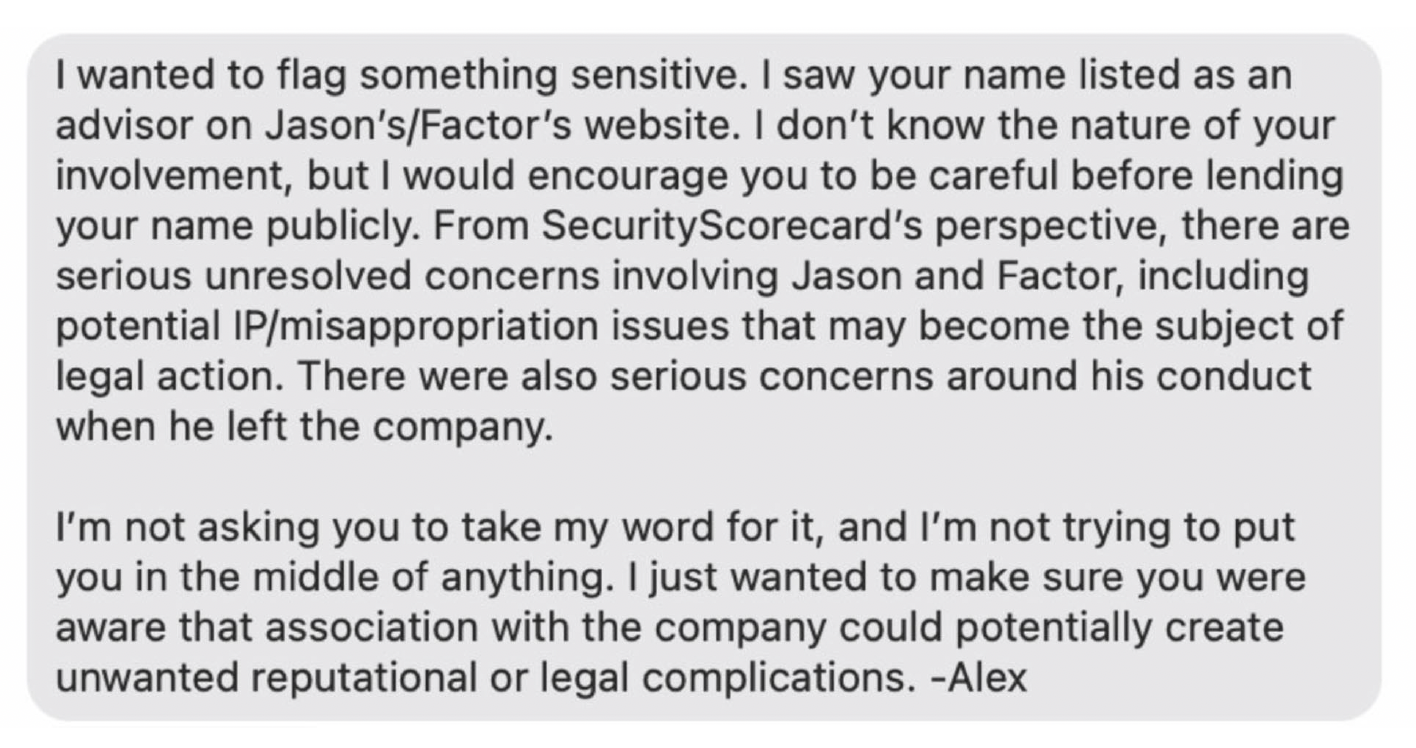
Message signed "-Alex" to a Factor advisor
Evidence carousel. Provided by the plaintiff; date and recipient not confirmed.
"I wanted to flag something sensitive. I saw your name listed as an advisor on Jason's/Factor's website. I don't know the nature of your involvement, but I would encourage you to be careful before lending your name publicly. From SecurityScorecard's perspective, there are serious unresolved concerns involving Jason and Factor, including potential IP/misappropriation issues that may become the subject of legal action. There were also serious concerns around his conduct when he left the company. I'm not asking you to take my word for it, and I'm not trying to put you in the middle of anything. I just wanted to make sure you were aware that association with the company could potentially create unwanted reputational or legal complications. -Alex"
Read as text
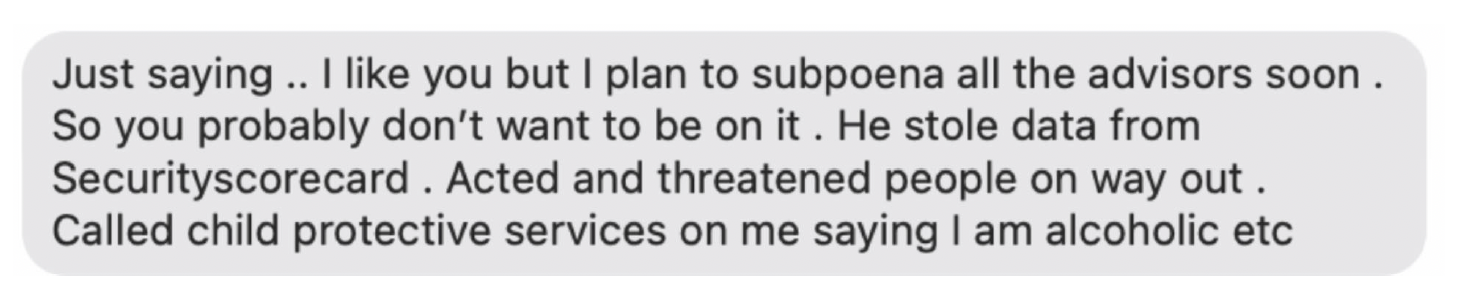
"Subpoena the advisors" message
Evidence carousel. Provided by the plaintiff; sender not shown in the screenshot. Contains unproven accusations against Thompson.
"Just saying .. I like you but I plan to subpoena all the advisors soon . So you probably don't want to be on it . He stole data from Securityscorecard . Acted and threatened people on way out . Called child protective services on me saying I am alcoholic etc"
Read as text
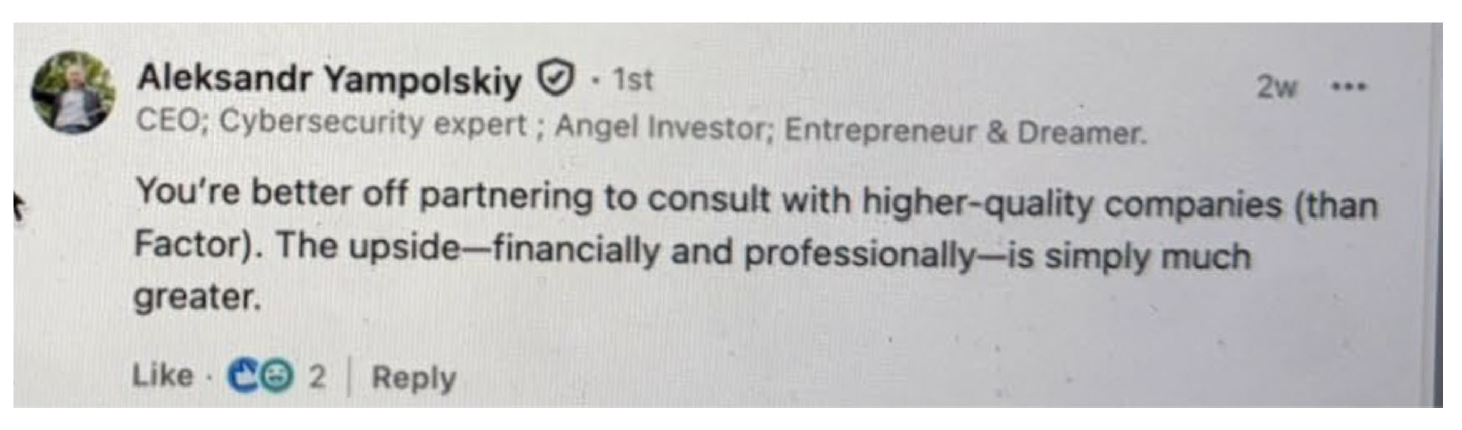
LinkedIn comment attributed to Aleksandr Yampolskiy
Evidence carousel. Date not confirmed (shown as "2w" ago).
Aleksandr Yampolskiy (CEO; Cybersecurity expert; Angel Investor; Entrepreneur & Dreamer): "You're better off partnering to consult with higher-quality companies (than Factor). The upside—financially and professionally—is simply much greater."
The three boxes are the statute's minimum. They are outlined because 3 screenshots of separate communications exist on this site, but none has independently verified authorship, one is about Factor rather than Thompson, and meeting the number is never enough: each incident must be part of a knowing course of conduct directed at Thompson that would cause a reasonable person fear of physical injury or significant mental anguish.
Date not shown · Documented screenshot · C1
A listed Factor advisor (not named in screenshot) — Private message
May be the same message the complaint cites at ¶ 41 (Tom Bain, May 2026). Counted once.
Date not confirmed · Documented screenshot · C3
Public (comment on a LinkedIn thread) — Public LinkedIn comment
July 12, 2026 (per site timeline) · Documented screenshot · C2
A Factor advisor — Text message
Wording overlaps the Norremo message quoted at Complaint ¶ 74. Possibly the same incident; counted once.
Table · Evidence ledger of distinct potential incidents
C1 · Date not shown
Documented screenshotA listed Factor advisor (not named in screenshot) · Private message
“be careful before lending your name publicly … association with the company could potentially create unwanted reputational or legal complications. -Alex”
- Source
- Evidence: “-Alex” message — Screenshot supplied by plaintiff; signed “-Alex”; sender account, date and recipient not independently verified.
- § 1312 status
- Candidate (communication about Thompson via a third party).
- Intent / effect / open questions
- Is the sender account Mr. Yampolskiy's? Is this the May 2026 Tom Bain message in ¶ 41? May be the same message the complaint cites at ¶ 41 (Tom Bain, May 2026). Counted once.
C2 · July 12, 2026 (per site timeline)
Documented screenshotA Factor advisor · Text message
“I plan to subpoena all the advisors soon … He stole data from Securityscorecard”
- Source
- Evidence: “Subpoena the advisors” message — Screenshot supplied by plaintiff; sender not shown in the image.
- § 1312 status
- Candidate (communication about Thompson via a third party).
- Intent / effect / open questions
- Authorship from carrier/device records. Same as the July 2026 Norremo message (¶¶ 44, 74 quote “stole data from Securityscorecard”)? Wording overlaps the Norremo message quoted at Complaint ¶ 74. Possibly the same incident; counted once.
C3 · Date not confirmed
Documented screenshotPublic (comment on a LinkedIn thread) · Public LinkedIn comment
“You’re better off partnering to consult with higher-quality companies (than Factor).”
- Source
- Evidence: LinkedIn comment — Screenshot of a public comment attributed to Mr. Yampolskiy; ¶ 45 describes such comments.
- § 1312 status
- Weak candidate: about Factor, not Thompson by name; public commentary.
- Intent / effect / open questions
- Date, thread owner, and whether it is “about” Thompson rather than his company.
A1 · May 2026
Allegation / third-party reportTom Bain, Factor advisor · Not specified
Described as a “threat” (¶ 41); the quoted image is not reproduced in the text version.
- Source
- Complaint ¶¶ 41, 74 — Allegation in a filed complaint; also referenced in Exhibit D.
- § 1312 status
- Candidate if distinct from C1.
- Intent / effect / open questions
- Original message, date, and whether it is C1. Possibly C1.
A2 · June 9, 2026 (reported)
Allegation / third-party reportA Factor business partner (unnamed) · Not specified
Partner “reported that Yampolskiy had contacted him immediately after Thompson posted event photographs … and … made false claims that Plaintiffs stole intellectual property”
- Source
- Complaint ¶ 43 — Third-party report relayed in the complaint; no message published.
- § 1312 status
- Candidate (distinct date and recipient).
- Intent / effect / open questions
- Partner testimony; the original contact; timing relative to Thompson's posts (monitoring element).
A3 · July 2026
Allegation / third-party reportAnders Norremo, Bitsight SVP and Factor advisor · Message
Stated that Thompson “stole data from Securityscorecard” (¶ 74)
- Source
- Complaint ¶¶ 44, 74; Exhibit D — Allegation in the complaint and counsel's letter.
- § 1312 status
- Candidate if distinct from C2.
- Intent / effect / open questions
- Original message; is it C2? Possibly C2.
A4 · By July 12, 2026
Allegation / third-party report“four of the six Factor associates” on factorcyber.com/team · Meetings or messages
“met with or sent messages to four of the six Factor associates” (¶ 46)
- Source
- Complaint ¶ 46 — Aggregate allegation; overlaps A1, A3, C1, C2.
- § 1312 status
- Unresolved: may add 0–2 incidents beyond those listed.
- Intent / effect / open questions
- Identify each of the four, each contact, and each date.
A5 · Reported July 13, 2026
Allegation / third-party reportThompson's prospective clients · LinkedIn
Thompson told police Mr. Yampolskiy contacted prospective clients “with false claims”
- Source
- Wilton Manors police report — Thompson's statement recorded by police; information report, no crime listed.
- § 1312 status
- Unresolved: number and dates of contacts unknown.
- Intent / effect / open questions
- Names of clients, the messages, and dates.
A6 · Ongoing (on information and belief)
Allegation / third-party reportThompson (monitoring) · Alleged monitoring by SSC IT staff
Yampolskiy “directed former head of information technology … to monitor Thompson’s online activity” (¶ 38)
- Source
- Complaint ¶ 38 — Pleaded on information and belief.
- § 1312 status
- Possible: § 1312(e)(1) lists “monitors.”
- Intent / effect / open questions
- Witnesses and internal records showing any instruction.
X1 · May 15, 2026
Excluded contextSSC board of directors · Cease-and-desist notice
Thompson asked SSC to “stop contacting Factor’s employees, advisors, customers, investors, and affiliates” (¶ 42)
- Source
- Complaint ¶ 42 — Sent by Thompson. Not an incident by anyone else.
- § 1312 status
- Excluded. Relevant only as notice and timeline marker.
- Intent / effect / open questions
- Who at SSC received it, and what was done.
X2 · July 14, 2026
Excluded contextThompson · Letter from SSC's counsel
Demand letter regarding property and the FACTOR mark
- Source
- Exhibit C — Litigation correspondence from counsel.
- § 1312 status
- Excluded: legal demand; ordinarily a legitimate purpose.
- Intent / effect / open questions
- —
X3 · Aug 19, 2026
Excluded context— · Police report
Thompson requested stalking charges
- Source
- Delaware State Police report — A report of alleged conduct, not an incident.
- § 1312 status
- Excluded (context).
- Intent / effect / open questions
- See fact check below.
3
Documented unique communications
Screenshots C1–C3. Authorship independently verified: 0. About Thompson by content: 2.
1 + unresolved
Allegations needing source records
A2 (June 9) is clearly distinct. A1 and A3 may duplicate C1 and C2. A4–A6 are unquantified.
3
Excluded context
Thompson's own May 15 notice, counsel's Exhibit C letter, and the police report.
Bottom line on the count: no reliable final number can be stated. The minimum supported by a document on this site is two private messages about Thompson plus one public comment about Factor, none with verified authorship. With the June 9 partner report, at least three distinct alleged communications about Thompson appear in the record; whether there are more depends on whether A1 and A3 are separate from C1 and C2 and on what A4–A6 would show.
03Why communications through advisors and partners might count
Most of the documented and alleged communications went to Factor's advisors, a business partner and prospective clients, not to Thompson. Delaware's definition expressly reaches acts done “indirectly, or through third parties” and acts that “communicate[] to or about another” or interfere with “employment, business, career.” On the statute's face, messages to Thompson's associates that are about Thompson are the kind of act that can be a predicate incident.
But two limits remain. The course of conduct must still be “directed at a specific person.” A message that is about Factor, a corporation, or that warns an advisor about litigation, may be directed at the company or at the advisor's decision rather than at Thompson. C1 and C2 name or describe Thompson (“Jason,” “He stole data”); C3 names only Factor. And the statutory examples of interference with a “business” or “career” describe what an incident can be, not what satisfies the separate effect element. Adverse economic consequences alone, such as a lost partnership (¶ 48), do not establish that a reasonable person would fear injury or suffer significant mental anguish.
04Mental state, effect, and plausible lawful explanations
For stalking, the question is whether the person knowingly engaged in the conduct, and whether the conduct would have the required effect on a reasonable person. For harassment, the question is intent to harass, annoy or alarm. Neither can be conclusively inferred from the words of one message. Investigators would look at the whole pattern: frequency, timing (for example, the June 9 contact reportedly came “immediately after” Thompson posted photographs, ¶ 43), whether contacts continued after a request to stop, and whether the content had any purpose besides causing distress.
There are lawful readings a prosecutor would weigh. SSC has asserted IP and trademark claims in writing (Exhibit C). A person who believes such claims are valid may warn third parties about potential subpoenas; “I plan to subpoena all the advisors” (C2) can be read as a litigation statement, though its accompanying accusations are disputed and allegedly false. Business competition and criticism are also common explanations. On the other side, the complaint says the communications were made after a request to stop, reached most associates on Factor's team page (¶ 46), and repeated accusations the plaintiffs say are false. Weighing those readings requires evidence beyond the screenshots, including Thompson's own account of the effect on him and objective corroboration of it.
05Conduct after the May 15, 2026 notice
On May 15, 2026, Thompson sent a cease-and-desist notice to SSC's board asking that SSC stop contacting Factor's “employees, advisors, customers, investors, and affiliates” (Complaint ¶ 42). That notice is Thompson's act. It is not an incident by anyone else and is excluded from the count. Its relevance is chronological: the complaint alleges conduct “not only continued, but it increased.”
After May 15, the record places: the June 9 partner report (A2); the July 2026 Norremo message (A3); the July 12 subpoena message (C2), which may be the same as A3; and Thompson's July 13 report to Wilton Manors police (A5). The Tom Bain message is dated only “May 2026,” so it is unknown whether it came before or after the notice. Under § 1312(h), lack of “actual notice that the course of conduct was unwanted” is not a defense, so notice is not an element; but continued contact after a written request can bear on whether conduct was knowing and on how a reasonable person would perceive it. Whether the board forwarded the notice to Mr. Yampolskiy is not documented.
- 1
Original message
Device, account, export with metadata
- 2
Authorship
Platform or carrier records; sender testimony
- 3
Separate incidents
Distinct date, recipient, act
- 4
Directed at Thompson
Content and purpose, incl. via third parties
- 5
Reasonable-person effect
Fear of injury or significant distress
- 6
Charging decision
Probable cause, then proof beyond reasonable doubt
06What a detective would investigate
- Preservation. Original messages on recipients' devices, with full headers, timestamps and account identifiers, not cropped screenshots; preservation requests to LinkedIn or carriers.
- Authorship. Which account sent each message, who controls it, and whether the sender of C2 is identifiable at all.
- Witness interviews. Tom Bain, Anders Norremo, the June 9 business partner, the four associates in ¶ 46, and the prospective clients, about what they received and how they understood it.
- Chronology. A dated sequence relative to Thompson's posts, the May 15 notice and the July 14 letter.
- Objective impact. Evidence of fear or significant distress measured against a reasonable person in Thompson's circumstances, including any history he reports, such as the 2025 threat he alleges (“You threatened to shoot me at 8:30 AM,” Thompson's own message; unproven).
- Authentic records. Business records custodians and forensic extraction, so evidence would be admissible.
- Jurisdiction. Where the sender and recipients were. Thompson reported to police in Delaware, Florida and Massachusetts; Delaware jurisdiction depends on where conduct occurred or took effect.
- Exculpatory evidence. Any legitimate litigation purpose, responses showing recipients were not alarmed, and anything showing a message was not sent by the person accused.
07How a prosecutor might evaluate it
A prosecutor would first ask whether there is probable cause for each element, then whether the evidence could prove each beyond a reasonable doubt. The options include declining, asking police for further investigation, referring to another jurisdiction, or charging. Prosecutors also weigh free-speech issues and the existence of a parallel civil suit. A criminal case is independent of the civil one: neither the filing nor the result of Factor's lawsuit decides whether a crime occurred, and prosecutors are not bound by allegations in a complaint. This site makes no prediction about any outcome.
08How civil discovery could, and could not, reach law enforcement
Discovery is not a shield. Testimony given in open court and exhibits filed on the public docket or admitted at trial are generally public records, and anyone, including the police or a prosecutor, may read and use them. That covers the complaint and exhibits already filed in this case. The main exception is material the court has ordered sealed.
Material that is only exchanged in discovery, and never filed, works differently. It may be covered by a protective order limiting its use to the litigation, and anything designated confidential under that order generally cannot be handed to police without the court's permission or the producing party's consent. Courts can modify protective orders, and many include exceptions for reporting suspected crimes. Parties also remain free to give police their own original records, and law enforcement can obtain records independently through a subpoena, warrant or grand-jury process. Privileged communications stay protected. Some records will reach investigators only through one of these routes, not automatically, and no discovery has occurred in this case to date.
09Fact check: the Delaware State Police report
- Report
- Delaware State Police, No. 07-26-056846
- Reported
- August 19, 2026 (site timeline)
- Classification
- Miscellaneous Investigation (code 8198)
- Status
- Pending-Inactive; pending supervisory review
“Jason Thompson reported alleged threats connected to an ongoing cybersecurity matter and requested stalking charges against Aleksandr Yampolskiy. Insufficient evidence existed to identify the caller or establish probable cause.”
What this means: police recorded the report and did not find probable cause on the evidence they had. It is not a finding that nothing happened, and not a finding that something did. “Pending-Inactive” means the file is open but not being actively worked. The report concerns a caller; it does not evaluate the written communications in the ledger. Read the full text.
10Disclosure and sources
This is analysis by a site owned by a plaintiff, not an official source and not legal advice. All allegations are unadjudicated. Mr. Yampolskiy has not been charged with any crime, and this article does not allege that he is guilty of stalking or harassment. Quoted statutory text is from the official Delaware Code as published on the date of this article; check the source for current law.
- 11 Del. C. §§ 1311–1312, official Delaware Code →
- Complaint, ¶¶ 38–48, 74 (text) →
- Exhibit D, Factor counsel letter, Aug. 10, 2026 →
- Delaware State Police report →
- Wilton Manors police report →
- Statutes appendix on the homepage →
Related investigations
Investigations · Federal investigation
FBI Launches Formal Probe into SecurityScorecard CEO Aleksandr Yampolskiy
The FBI’s Boston Cyber Task Force interviewed multiple witnesses about Yampolskiy’s alleged access to Bitsight and requested evidence tracing Bitsight material into SecurityScorecard’s product.
Opinion
DOJ Flameout and Yampolskiy’s Criminal Defense Attorney Michael Yaeger Acts Unethically, Then Complains About the Consequences
A day after his firm sent preservation letters to a Factor executive and an advisor, Yampolskiy’s defense attorney Michael Yaeger demanded that the Chronicle come down. His email identified no factual error in the articles he attached.
Opinion
Crooked Michael Margulies Used Preservation Letters to Intimidate Witnesses
On November 19, Carlton Fields attorney Michael D. Margulies emailed a Factor Cybersecurity executive and an advisor at their personal addresses. They were already represented by counsel.
Analysis · Executive accountability
From NS8 to SecurityScorecard: When Cybersecurity Executives Become the Risk
The NS8 scandal exposed fraud and whistleblower retaliation inside a company selling fraud prevention. Allegations in Factor Cybersecurity's federal lawsuit raise a different question: Who holds cybersecurity executives accountable when their own conduct is challenged?
Investigations · Legal Analysis
AleksandrYampolskiy.com: A Masterclass in Leveling the Playing Field Through Asymmetric Advantage
SecurityScorecard's CEO publicly criticized a former executive and his startup. A landmark federal appellate decision involving Jerry Falwell explains why an independent criticism website bearing his name is not unlawful merely for using it, and how modern tools let founders level the playing field.
Analysis · Computer Fraud and Abuse Act
Did Yampolskiy's Alleged Competitor Hacking Cross the Line Drawn by the Supreme Court in Van Buren?
How the Supreme Court’s landmark CFAA decision applies to alleged unauthorized competitor access described in Factor Cybersecurity v. SecurityScorecard, and why valid credentials do not necessarily establish lawful authorization.
Investigations · Litigation
Something to Hide? Yampolskiy's SecurityScorecard Settled Competitor Lawsuit Just 10 Days After Judge Ordered Competitive Intelligence Discovery
SecurityScorecard sued a competitor over alleged improper competitive intelligence gathering. But when a federal judge ordered scrutiny of SecurityScorecard's own practices, the case settled just ten days later. Coincidence, or did the discovery order change everything?
Investigation · Litigation tactics
Drug Use, Threats, and Anonymous Emails: Who Are theothermarkh@proton.me and markh1980ny@gmail.com, and Why Do They Matter to SecurityScorecard & Yampolskiy's Defense?
Two unidentified email accounts. Allegations of antisemitic statements, threats, and drug use in federal litigation involving a longtime SecurityScorecard executive. And the same outside attorney raising questions about anonymous communications in another lawsuit. Is there a recurring litigation strategy, or something more troubling happening inside SecurityScorecard?
Analysis · Litigation exposure
From Unicorn to Firesale: Why Impacted Companies Hold SecurityScorecard’s Death Warrant
If allegations of unauthorized access to competitor platforms were ever corroborated, the leverage would sit with the companies allegedly accessed. A conditional, claim-by-claim look at the civil, criminal, commercial and valuation stakes, with an interactive model.
Litigation · Evidence · Corporate Conduct
Bad Faith: Factor Offered a Code Review to Yampolskiy's Attorneys. It Was Never About IP. This Was About Bullying.
SecurityScorecard was offered multiple opportunities to resolve its concerns, including third-party forensic examination and access to Factor's application codebase. Why did a dispute that could have been investigated privately become a federal lawsuit and a public confrontation?
Analysis · Commentary on the court record
Watching for the Response: In the Heid Lawsuit, SecurityScorecard’s Hired Guns Went Scorched Earth
A former executive alleged his name and altered likeness were used to sell AI products, and that his equity was threatened when he objected. SecurityScorecard answered with two contract counterclaims and a set of personal allegations. One case, read closely, through both filings.
Board Spotlight · Governance
Richard Seewald Promised Billions. The Record Shows a Revolving Door, a 70% Markdown and a Fight SecurityScorecard Didn’t Need
An investor’s thirteen-year bet, a billion-dollar projection, a secondary-market markdown, and the governance test confronting Evolution Equity Partners.
Investigation · Evidence
The Smoking Gun: What Evidence Would Determine If Yampolskiy Hacked Competitors, and Does Factor Have It?
A Slack message, a Dropbox link, an access log, an invoice. What the federal record already holds on alleged competitor access, what discovery would have to establish, and why each link in the chain must stand on its own.
Featured Analysis · Counsel
Yampolskiy Hires White Collar Criminal Defense Attorney. What Does It Signal, and What Is Pro Hac Vice?
October 5 court filing identifies Michael L. Yaeger among three Carlton Fields attorneys representing SecurityScorecard and Aleksandr Yampolskiy.
Analysis · Corporate governance
SecurityScorecard’s Board Was Warned. Could Shareholders Sue Under Caremark?
How Delaware’s Caremark doctrine could expose longtime directors to liability if they ignored warnings of alleged executive misconduct.
Featured Analysis · Discovery
Following the Evidence: Emma Mason Furniture, Alleged Cyber Espionage, and Federal Discovery
How a federal trial could confirm or disprove the alleged Emma Mason Furniture hacking scheme and Aleksandr Yampolskiy's involvement.