Drug Use, Threats, and Anonymous Emails: Who Are theothermarkh@proton.me and markh1980ny@gmail.com, and Why Do They Matter to SecurityScorecard & Yampolskiy's Defense?
Two unidentified email accounts. Allegations of antisemitic statements, threats, and drug use in federal litigation involving a longtime SecurityScorecard executive. And the same outside attorney raising questions about anonymous communications in another lawsuit. Is there a recurring litigation strategy, or something more troubling happening inside SecurityScorecard?
14 min readInvestigation · Allegations unadjudicated
Raised by SecurityScorecard’s outside counsel · Aug. 17, 2026 letter
theothermarkh@proton.meOwner unidentified
markh1980ny@gmail.comOwner unidentified
Both addresses appear in an August 17, 2026 letter from SecurityScorecard’s counsel, Paul B. Keller, to Factor’s attorney, asking Factor to confirm whether Jason Thompson used them to communicate with SecurityScorecard employees or investors. No connection to Thompson or Factor has been shown. The underlying messages have not been produced.
01Two anonymous identities
Two email addresses have surfaced in the dispute between SecurityScorecard and Factor Cybersecurity: theothermarkh@proton.me, a Proton Mail account built for anonymity, and markh1980ny@gmail.com. Neither carries a full name. Both appear in an August 17, 2026 letter from Paul B. Keller, the outside lawyer defending SecurityScorecard and its chief executive, Aleksandr Yampolskiy, to Factor’s attorney, Benjamin J. Schladweiler of Greenberg Traurig. On pages 2–3, Keller wrote:
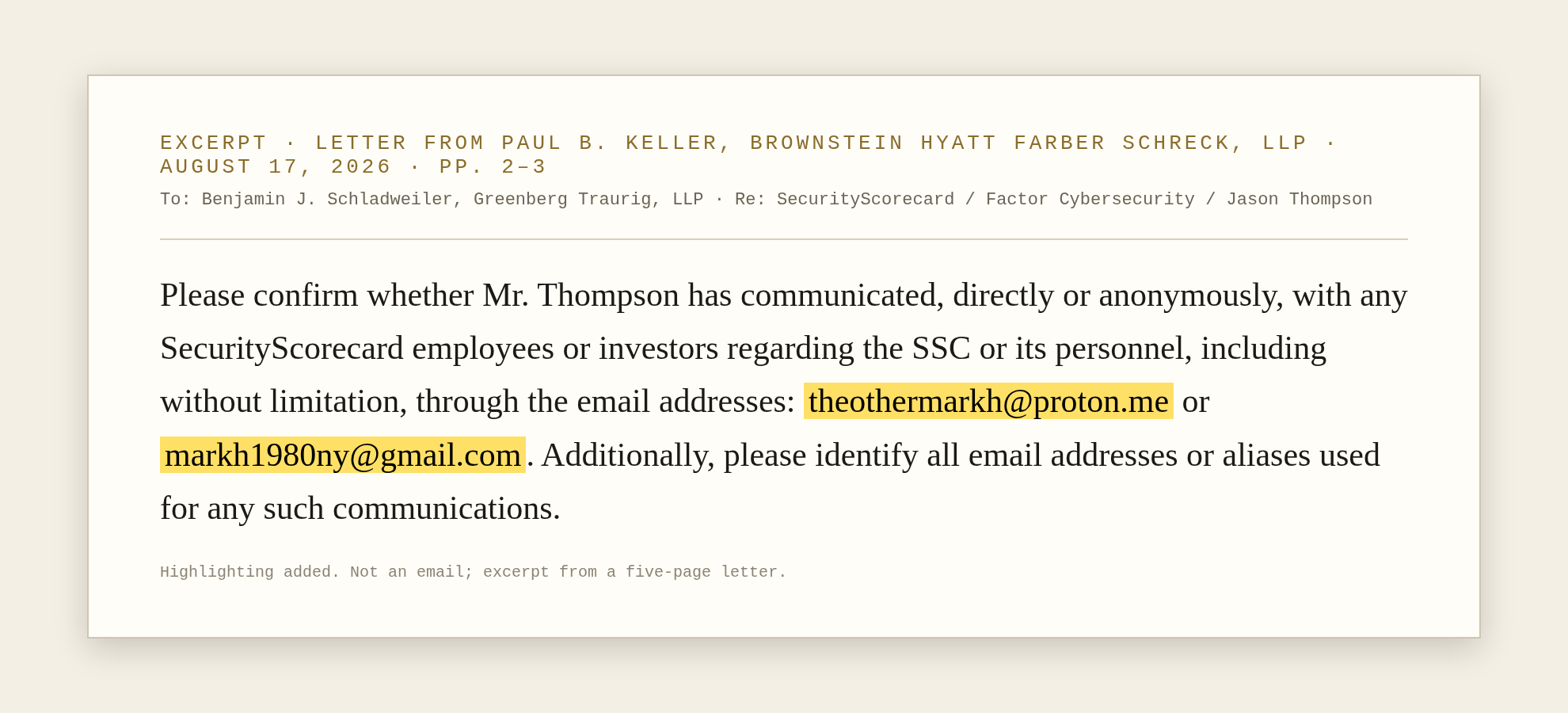
“Please confirm whether Mr. Thompson has communicated, directly or anonymously, with any SecurityScorecard employees or investors regarding the SSC or its personnel, including without limitation, through the email addresses: theothermarkh@proton.me or markh1980ny@gmail.com. Additionally, please identify all email addresses or aliases used for any such communications.”
Figure 0. Excerpt from an August 17, 2026 letter from Paul B. Keller of Brownstein Hyatt Farber Schreck, LLP, representing SecurityScorecard, to Benjamin J. Schladweiler of Greenberg Traurig, LLP, representing Factor. Pages 2–3. The letter requests confirmation regarding communications involving two specified email addresses. The excerpt does not establish that either address belonged to or was operated by Jason Thompson or Factor. Highlighting added.
Text of the excerpt. Letter dated August 17, 2026, from Paul B. Keller, Brownstein Hyatt Farber Schreck, LLP, to Benjamin J. Schladweiler, Greenberg Traurig, LLP, re: SecurityScorecard / Factor Cybersecurity / Jason Thompson, pages 2–3: “Please confirm whether Mr. Thompson has communicated, directly or anonymously, with any SecurityScorecard employees or investors regarding the SSC or its personnel, including without limitation, through the email addresses: theothermarkh@proton.me or markh1980ny@gmail.com. Additionally, please identify all email addresses or aliases used for any such communications.” Highlighting added.
The answer matters less than the question. Nothing connects either account to Thompson or Factor, and the correspondence offers no evidence that would. The messages themselves have not been produced, and their senders, recipients, dates and contents are unknown to this site. What the inquiry does establish is narrower and more revealing: someone has been writing to people at or around SecurityScorecard under identities that conceal who they are, and the company cared enough to have its litigation counsel ask its opponent about it.
Lawyers do not usually spend letters on routine spam. When outside counsel names specific accounts and asks a litigation opponent to account for them, the most natural reading is that the messages touched something the company considered sensitive: its people, its investors or its conduct. The question this story pursues is why that inquiry was pointed at an opponent, and what the company’s lawyer did the last time an anonymous identity crossed his path.
02What is happening inside SecurityScorecard?
Anonymous messages to executives, employees, directors or investors can mean many things. They may come from whistleblowers who fear retaliation, from employees with grievances, from investors with questions they do not want traced back to them, or from outside critics. Some are harassment. Some contain information a board is obligated to take seriously. The format alone proves nothing about the sender’s motive or the truth of what they wrote.
That is why the questions that follow are concrete. What did the messages say? Were they sent to employees, executives, investors or board members? Did they complain about how the company was being run, or about specific people? And what, if anything, led SecurityScorecard’s lawyer to think Thompson might be behind them? A company that receives anonymous complaints about its own conduct faces a choice: investigate the complaints, or investigate the complainers. Directing the inquiry at a litigation opponent, without stated evidence, suggests the second.
03The Heid case: drugs, threats and antisemitism
To understand why the letter’s inquiry deserves scrutiny, read Keller’s earlier work. On February 28, 2025, Alexander Heid sued SecurityScorecard and Yampolskiy in the Southern District of New York (Doc. 1; readable text). Heid had joined the company around November 2013 and served about ten years as chief research and development officer before his employment ended in March 2024. His complaint alleges that the company then built its HEID AI advertising, including materials displayed at the 2024 RSA Conference, around his name and a robotically altered version of his leadership-page photo (¶¶ 25–32, Figs. 1–5). It also alleges that after his lawyer’s June 6, 2024 demand letter, Yampolskiy texted him “I can always claw back your shares” and “[w]ould you prefer us to do it[?]”, and that the company then revoked an extension of his option-exercise window (¶¶ 63–68). Those are Heid’s allegations; they were never adjudicated.
On April 16, 2025, Keller, then at Crowell & Moring, filed the defendants’ answer and SecurityScorecard Inc.’s counterclaims (Doc. 14; readable text). The counterclaims were contract claims: Heid had allegedly released claims in his separation agreement and assigned rights in an invention-assignment agreement, and he had allegedly cheered the HEID campaign internally with messages such as “Hahaha t[h]is is awesome” (¶¶ 12–16). That is a coherent defense to a likeness claim. It needs no reference to Heid’s character.
Yet before reaching those claims, the pleading opens a “Background” section that does something else entirely. Paragraph 6 alleges, “upon information and belief,” that Heid controls social-media accounts under the pseudonym “Jake Newman.” Paragraph 7 says activity on that account was “highly offensive and derogatory, including purported racist and antisemitic commentary by followers of the ‘Jake Newman’ account.” Read carefully, the antisemitic remarks are attributed to the account’s followers, not to Heid, and the link between Heid and the account is itself asserted only on belief. Paragraph 9 repeats an unnamed third party’s claim that Heid sent emails “attacking” the third party’s family and is “mentally unstable and medicates himself with heavy drugs.” Paragraph 11 says Heid left “incoherent and aggressive voicemails” on July 4, 2024, in which he “appeared to sound heavily medicated or intoxicated.”
Primary-source excerpts · tap to expand
Doc. 14, Counterclaims ¶ 6, p. 10 (Apr. 16, 2025)
“Upon information and belief, Plaintiff controls social media presences on multiple platforms under the pseudonym ‘Jake Newman.’”
“…numerous of Plaintiff’s social media activities associated with the ‘Jake Newman’ pseudonym were highly offensive and derogatory, including purported racist and antisemitic commentary by followers of the ‘Jake Newman’ account.”
“SSC Inc. received communications from a third party indicating that Plaintiff sent ‘extremely inappropriate emails…’ and that Plaintiff is ‘mentally unstable and medicates himself with heavy drugs.’”
“…several incoherent and aggressive voicemails to key members of SSC Inc.’s leadership team in the early morning hours of July 4, 2024, where Plaintiff appeared to sound heavily medicated or intoxicated.”
“…Yampolskiy sent multiple threatening texts to Plaintiff, wherein he stated, inter alia, ‘I can always claw back your shares’ and ‘[w]ould you prefer us to do it[?]’”
None of those paragraphs is tied to an element of breach of release or breach of an assignment agreement. No document is attached. The third party is not named. The pseudonymous account is not shown to be Heid’s. And the drug allegation is not even the company’s own assertion: it is a stranger’s description, filtered through “communications” the company says it received, placed on a public federal docket where it could be read, indexed and quoted indefinitely. The case was dismissed on July 23, 2025 (Doc. 27) without any court testing those paragraphs. Heid has never been found to have used drugs, threatened anyone, or written anything antisemitic, and this article does not suggest he did.
04What did the company know, and when?
SecurityScorecard’s own pleading creates a governance problem it never addresses. The company says it received complaints about the “Jake Newman” identity on or about February 26, 2024, while Heid was still a senior executive, and that his behavior had grown “increasingly erratic and unstable” “over the last few years” (¶¶ 8–9). If that is true, the company had concerns about one of its most senior officers for years. Were they reported to the board? Was there an investigation? Was anyone protected?
The pleading does not say. Ten years of employment is not evidence the company tolerated misconduct, and this site draws no such inference. But a company cannot have it both ways. Either it had serious, documented concerns about a senior executive and should be able to show what it did about them, or the concerns were assembled after he sued. Employees, directors and investors are entitled to know which. For a company that sells cyber-risk ratings on the premise that it can see what others miss, the question of what its leadership knew about its own executive suite is not academic.
05A recurring pattern of anonymous identities
Set the two cases side by side and a shape emerges. In each, an opponent sued SecurityScorecard and Yampolskiy. In each, Keller represented the defense. And in each, an anonymous identity was associated with the opponent without disclosed evidence that the opponent controlled it: “Jake Newman” in Heid’s case, two email accounts in Factor’s.
Figure 2 · Two cases, one lawyer, two anonymous identities
Former chief research and development officer, about ten years at the company
Former employee and founder of a competing startup
Defense counsel
Paul B. Keller (Crowell & Moring)
Paul B. Keller (Brownstein Hyatt Farber Schreck)
Anonymous identity raised
“Jake Newman” social-media accounts
theothermarkh@proton.me · markh1980ny@gmail.com
How it was tied to the opponent
“Upon information and belief,” in a public pleading
Question to opposing counsel
Evidence of control shown
None in the pleading
None disclosed
Inflammatory content attached
Racist and antisemitic comments by the account’s followers; third-party “heavy drugs” quote; “intoxicated” voicemails
Not known
Needed for the claims pleaded?
No. Counterclaims were breach of release and of an assignment agreement
Not yet known
The differences matter. In Heid, the association was made publicly, in a signed pleading, and it came packaged with antisemitism, drugs and threats. In Factor, so far, it is a question in private correspondence. Asking an opponent a question is ordinary fact-finding. But the Heid filing shows what can follow when a question becomes an allegation: material that has nothing to do with the claims, attached to a name, on a docket the public can search. The strongest reading of the Heid record is that the personal paragraphs were included for their effect on Heid’s reputation, not their bearing on the contract claims. The Keller letter fits that history. Twice now, the same lawyer has reached for an anonymous or unknown identity and pointed it at the person suing his clients, without disclosing anything that ties the identity to that person. In this site’s view, that is a scare tactic: it tells an opponent that their name may be attached to whatever those accounts said, and it invites them to wonder what will appear in the next filing. Whether the same approach is now being prepared against Thompson is exactly what SecurityScorecard should be asked.
06Rule 11, Rule 12(f) and New York’s ethics rules
Federal pleadings are not a free-speech zone. A lawyer’s signature certifies that a filing is not presented “for any improper purpose, such as to harass” (Rule 11(b)(1)) and that its factual contentions have evidentiary support (Rule 11(b)(3)). Courts may strike “immaterial, impertinent, or scandalous matter” (Rule 12(f)), and courts have used that power for unsupported accusations of personal depravity that do not bear on any claim. 28 U.S.C. § 1927 reaches lawyers who multiply proceedings vexatiously.
Makes deceit or collusion by an attorney, with intent to deceive the court or a party, a misdemeanor with treble damages.
Federal judges in the Southern District of New York apply New York’s Rules of Professional Conduct to lawyers before them (Local Civil Rule 1.5). Whether any rule was violated is for a court or an Attorney Grievance Committee to decide.
New York’s rules, which apply to lawyers in the Southern District, add their own limits. Rule 4.4(a) forbids means that have “no substantial purpose other than to embarrass or harm a third person.” Rule 3.1 treats conduct that serves merely to harass or maliciously injure as frivolous. Rule 8.4(d) bars conduct prejudicial to the administration of justice. And Judiciary Law § 487 punishes attorney deceit intended to mislead a court or party, though it requires proof of intent that goes well beyond a weak allegation.
Why would a lawyer risk any of this? Part of the answer is New York’s litigation privilege. Statements made in court filings are absolutely privileged from defamation claims if they are pertinent to the litigation, and courts read “pertinent” generously. Repeating an anonymous third party’s claim that someone “medicates himself with heavy drugs” in a newspaper could invite a defamation suit. Repeating it in a pleading, “upon information and belief,” largely does not. That is why the rules above exist: the privilege protects filings from defamation suits, but not from a court’s power to strike them or sanction the lawyer who signed them.
Applied here, the analysis is straightforward. The drug, antisemitism and threat paragraphs were not needed to plead breach of a release or an assignment agreement. They rest on belief, an unnamed source and a lawyer’s characterization of how someone sounded on a voicemail. That is precisely the kind of matter Rules 11(b)(1), 12(f) and 4.4(a) are designed to reach, and in this site’s view it was a tactic aimed at the opponent rather than the claims. Repeatedly tying unidentified accounts to opposing parties without evidentiary support may violate the federal rules’ evidentiary-support and improper-purpose requirements and New York’s prohibitions on conduct meant to embarrass, harass or intimidate. But a violation is a legal conclusion that requires a ruling. Heid did not obtain one before the case was dismissed, no court has sanctioned Keller, and no grievance committee has made any finding.
Evidence status
Documented fact
Keller signed Doc. 14 and, in an Aug. 17, 2026 letter, asked Factor’s counsel about the two email addresses.
Documented fact
SecurityScorecard’s counterclaims were contract claims that did not depend on Heid’s character.
Disputed allegation
That Heid controlled “Jake Newman,” took drugs, or sent threatening messages.
Disputed allegation
That Yampolskiy threatened to “claw back” Heid’s shares.
Investigative inference
The personal paragraphs served no pleaded purpose and read as an effort to damage Heid on the public docket.
Unresolved question
Who controls the two email accounts, and what the messages said.
07The questions SecurityScorecard should answer
Who controls theothermarkh@proton.me and markh1980ny@gmail.com?
What communications from those accounts did SecurityScorecard receive or obtain?
Who received them, and what did they concern?
What evidence led Keller to ask whether Factor or Thompson was involved?
What evidence showed that Heid controlled the “Jake Newman” accounts?
What supported the allegations of drug use, antisemitic content and threats, and how were they relevant to contract counterclaims?
What did SecurityScorecard’s leadership and board know about any alleged executive misconduct, and when?
Are these unrelated disputes, or a recurring way of defending litigation?
Why do anonymous identities keep appearing in SecurityScorecard’s legal disputes, and what evidence supports the company’s efforts to pin them on its opponents?
The FBI’s Boston Cyber Task Force interviewed multiple witnesses about Yampolskiy’s alleged access to Bitsight and requested evidence tracing Bitsight material into SecurityScorecard’s product.
A day after his firm sent preservation letters to a Factor executive and an advisor, Yampolskiy’s defense attorney Michael Yaeger demanded that the Chronicle come down. His email identified no factual error in the articles he attached.
On November 19, Carlton Fields attorney Michael D. Margulies emailed a Factor Cybersecurity executive and an advisor at their personal addresses. They were already represented by counsel.