Investigations · Attorney grievance
Yampolskiy’s Hired Gun Michael Margulies Named in Complaint to New York’s Attorney Grievance Committee
On October 30 Michael D. Margulies sent an arbitration demand against a company that says it never agreed to arbitrate. On November 19 he invoked that proceeding in personal emails to two members of its leadership, asking them to enlist their staff and IT providers.
The signed November 22 grievance asks the Attorney Grievance Committee of the New York Supreme Court, Appellate Division, First Judicial Department, whether Margulies used a second legal proceeding to harass Factor Cybersecurity and bypassed counsel to reach a represented executive. Margulies is a Carlton Fields lawyer acting for SecurityScorecard.
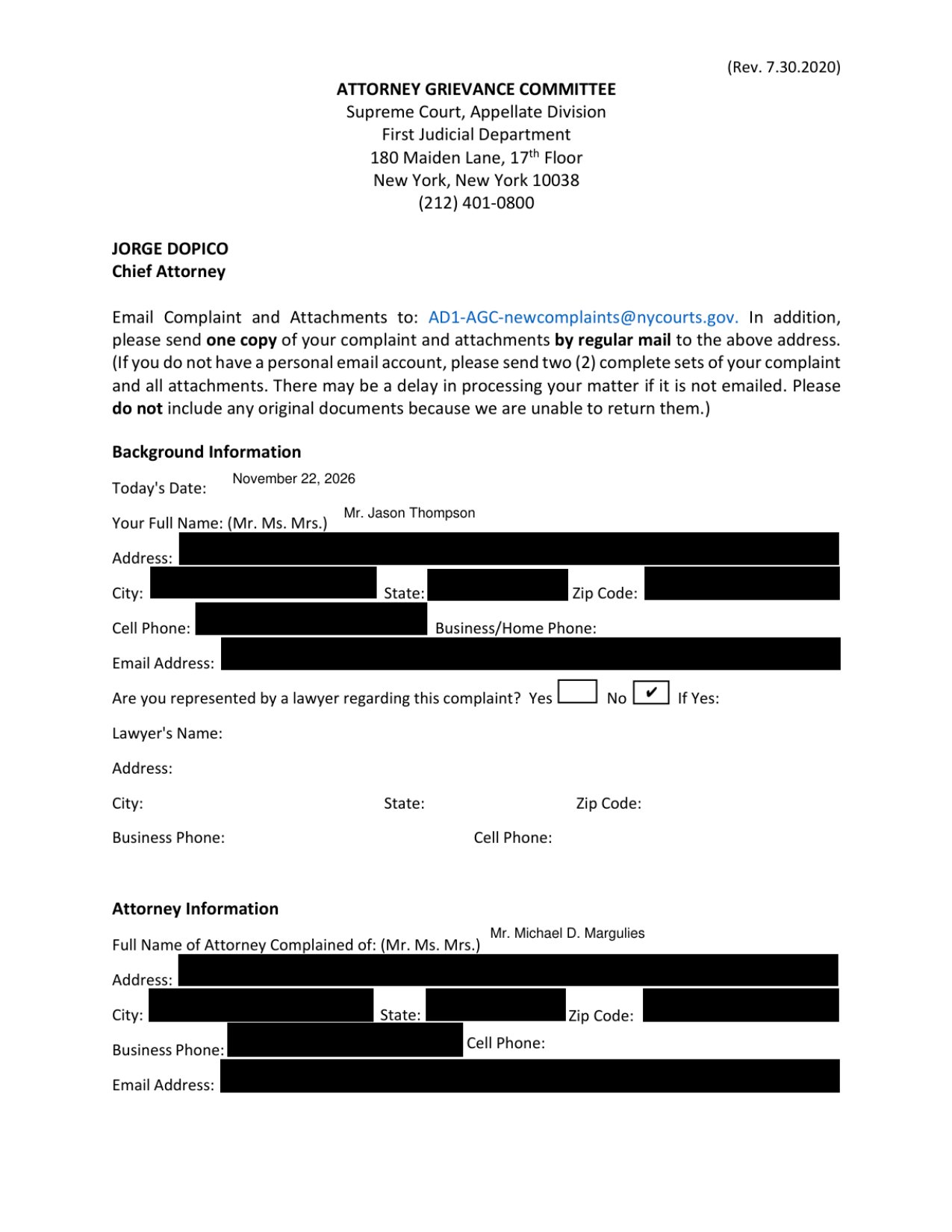 Page 1 of 34
Read as text
Redacted grievance against Michael D. Margulies, page 1
Grievance article: first page of the Chronicle-hosted redacted grievance and Exhibits A–K (34 pages), supplied by the site owner.
Form page, marked "(Rev. 7.30.2020)". ATTORNEY GRIEVANCE COMMITTEE, Supreme Court, Appellate Division, First Judicial Department, 180 Maiden Lane, 17th Floor, New York, New York 10038, (212) 401-0800. JORGE DOPICO, Chief Attorney. "Email Complaint and Attachments to: AD1-AGC-newcomplaints@nycourts.gov. In addition, please send one copy of your complaint and attachments by regular mail to the above address. (If you do not have a personal email account, please send two (2) complete sets of your complaint and all attachments. There may be a delay in processing your matter if it is not emailed. Please do not include any original documents because we are unable to return them.)" Background Information. Today's Date: November 22, 2026. Your Full Name: Mr. Jason Thompson. Address, City, State, Zip Code, Cell Phone and Email Address: [redacted]. Business/Home Phone: [blank]. Are you represented by a lawyer regarding this complaint? Yes [unchecked], No [checked]. Lawyer's Name, Address, City, State, Zip Code, Business Phone, Cell Phone: [blank]. Attorney Information. Full Name of Attorney Complained of: Mr. Michael D. Margulies. Address, City, State, Zip Code, Business Phone and Email Address: [redacted]. Cell Phone: [blank].
The document
The grievance and Exhibits A–K, as sent to the First Department
Redacted · 34 pages · November 22, 2026
Download the redacted grievance and exhibits (PDF, 34 pages)
The unsigned agreement
Factor’s founder signed an arbitration agreement with SecurityScorecard in 2017, during his first period of employment there (Exhibit K, p. 3). On May 17, 2023, he signed a contractor agreement. Its section 21 says it “supersedes any and all pre-existing agreement, written or oral, between the parties.” Its section 20 sends disputes arising from or relating to that agreement to the state and federal courts in New York County (Exhibit K, p. 4).
The June 22 employment offer reset the terms a second time. Its “Entire Agreement” clause says that the letter and the documents it incorporates supersede all earlier or contemporaneous agreements and understandings, oral or written, on the same subject. The contractor agreement had selected courts in New York County for contractor disputes (Exhibit K, p. 4). The employment offer selects New York law and leaves the choice of court open. The offer itself contains no arbitration clause, no assignment of inventions and no non-disparagement covenant.
Page 2 of the offer shows which promise the employee actually made: to keep the company’s trade secrets and proprietary or confidential information confidential during and after employment. The same page says the employee “will be required” to sign the company’s separate standard inventions and non-competition agreement. The completed DocuSign envelope contains the three-page offer and a one-page background-check authorization. The standard agreement is absent. SecurityScorecard’s case for arbitration therefore turns on its claim that signing the offer incorporated the unsigned form (grievance, p. 2; Exhibit K, p. 4).
Source: SecurityScorecard employment offer, June 22, 2023, pp. 2–3; DocuSign certificate of completion, p. 5 (offer identified as Exhibit D in the Yaeger declaration). The offer’s supersession clause is also described in Factor’s Delaware complaint, ¶ 21.
SecurityScorecard knew about the supersession objection when it filed. Its own demand, at printed pages 22–23, recites the objection and disputes it, arguing that the June offer letter and a later MAX bonus letter incorporated or reaffirmed its standard employment terms (Exhibit K, p. 4).
On November 3, SecurityScorecard asked the Delaware federal court to stay Factor’s lawsuit pending arbitration. Michael L. Yaeger, a different Carlton Fields attorney, filed the supporting declaration. He submitted SecurityScorecard’s unsigned standard 2023 agreement as Exhibit E, identified it as the standard form, and argued that the offer letter incorporated it by reference (Exhibit K, p. 3; exhibit dates, p. 34). The grievance does not allege a forged signature. It challenges the assent counsel asserted on the strength of a form nobody signed.
Confidentiality matters to the Bitsight allegations for a different reason. The promise on page 2 of the offer covers the company’s trade secrets and proprietary or confidential information. It does not cover criminal acts. Unauthorized access to a competitor’s platform, the conduct Yampolskiy has been credibly accused of, is not a SecurityScorecard trade secret, and no confidentiality clause turns it into one.
Why a second forum matters
New York Rule 3.1(a) bars a lawyer from bringing a proceeding, or asserting a position in one, without a basis in law and fact that is not frivolous. Rule 3.1(b)(2) defines conduct as frivolous when it “serves merely to harass or maliciously injure another” (Exhibit K, p. 4).
Both entire-agreement clauses bear on that standard. The founder’s signed arbitration agreement dates from 2017, his first period of employment at SecurityScorecard, which ended in 2019 (Exhibit K, p. 3; complaint, ¶ 14). The May 17 contractor agreement superseded any pre-existing agreement between the parties. The June 22 offer superseded earlier agreements on the same subject and added no arbitration clause of its own. A demand to arbitrate therefore needs a basis that survives two later integration clauses, and the basis SecurityScorecard offers is incorporation of an unsigned form. Its stay motion asks the Delaware court to accept that theory. The grievance asks the committee whether pressing it had a nonfrivolous basis.
The grievance applies both provisions. It alleges Margulies pursued arbitration without a good-faith basis for binding either respondent after supersession, and sought acceptance of service in a second forum. SecurityScorecard then used the demand to seek a stay of the Delaware case. Defending a second proceeding increased Factor’s costs. Then Margulies reused the arbitration to make demands on its people. That sequence, the grievance says, shows the improper purpose (Exhibit K, p. 3; p. 4).
Delaware’s Lawyers’ Rule 3.1 imposes the same requirement of a nonfrivolous basis. The federal court in Delaware adopts the ABA Model Rules for lawyers practicing before it, subject to its own modifications, under Local Rule 83.6(d) (Exhibit K, p. 4; grievance, p. 7).
A deadline for Factor’s leadership
Margulies addressed his November 19 preservation letters individually: one to Factor’s co-founder and VP of Growth, whom he identified as “Co-Founder and Vice President of Growth for Factor,” and one to a strategic advisor who had joined days earlier (Exhibit A, pp. 9–11; Exhibit B, pp. 12–14; statement, p. 6).
Factor’s counsel, Charles Brown, represented the VP in the matter (grievance, p. 2). Margulies copied Brown. He also asked the VP to acknowledge receipt directly and name a preservation contact by December 4 (Exhibit A, p. 10). The grievance says he never consulted Brown or obtained his consent (statement, p. 6). The copy shows Brown received notice. It does not, by itself, supply permission.
New York Rule 4.2(a) bars a lawyer from communicating about the subject of a representation with a party the lawyer knows is represented in the matter, unless the other lawyer gives prior consent or the law authorizes the contact. Delaware Lawyers’ Rule 4.2 adds contact authorized by court order. Comment [7] to the Delaware rule extends protection to certain constituents of a represented organization: those who supervise, direct or regularly consult with its lawyer about the matter, who can bind it, or whose conduct may be imputed to it (grievance, p. 7).
The VP was represented. Whether the rule also covers the advisor depends on whether he was represented in the matter or carried actual authority for Factor in it (statement, p. 6).
What the letters told them to do
The letters requested preservation only. They disclaimed any demand for production or waiver of privilege (Exhibit A, p. 10). Within that frame, they asked a great deal. Each recipient was told to “notify any of your personnel reasonably likely to hold relevant records” and “coordinate with appropriate IT personnel or service providers” to suspend routine deletion, auto-delete and ephemeral-message settings. Each was told to preserve native files and metadata, and records not yet created (Exhibit A, p. 9; Exhibit B, p. 12).
The period began January 1, 2017. The advisor had joined Factor days before the letter reached him (grievance, p. 7; Exhibit B, p. 12).
New York Rule 4.4(a) bars means that have no substantial purpose other than to embarrass or harm a third person. Delaware’s version adds “delay, or burden.” The grievance alleges that sending these demands to the recipients personally served no substantial purpose beyond intimidating and burdening them, and says the letters’ stated preservation purpose bears directly on that question (grievance, p. 7).
The accusations in the letters
Both letters opened by describing the dispute as involving “unauthorized use of SSC’s intellectual property, bad faith, and breach of fiduciary duty” (Exhibit A, p. 9; Exhibit B, p. 12). The grievance calls their circulation to people whose trust Factor depends on defamatory (statement, p. 6). Factor’s federal complaint alleges its founder never had access to SecurityScorecard’s source code or trade secrets.
The grievance asks for review under Rule 4.1 and Rule 8.4(c) if the evidence shows a knowingly false statement or dishonesty by counsel. Delaware’s Rule 4.1(a) also requires that the false statement be material (grievance, p. 7). Repeating a client’s disputed accusation is one thing. Knowingly misstating a fact is another. The committee would have to find the second.
Why these two recipients
Yampolskiy had targeted both of them before Margulies wrote. On or about December 18, 2025, he publicly urged the VP, then a consultant, to partner with “higher-quality companies (than Factor)” (Exhibit C, p. 15; p. 8).
On June 18, 2026, Cobalt AI announced the advisor’s appointment as its CTO. Beneath it, Yampolskiy wrote: “You guys should probably coach your CTO - not to send retarded messages to Executives on LinkedIn.” The comment carries no visible timestamp. The grievance dates it between June 18 and June 28 (Exhibit D, p. 16; p. 34).
The witness who got the warning
A second Factor advisor, then at Bitsight, led its investigation into the account at issue. According to the grievance, his team identified the “Emma Mason” account, disabled it, and the unauthorized access stopped (p. 8).
In July, that advisor relayed a message from Yampolskiy: “I plan to subpoena all the advisors soon” and “So you probably don’t want to be on it” (Exhibit E, p. 17). The grievance dates the message to about July 12. It asks the committee to examine whether Yampolskiy directed what Margulies later did (grievance, p. 2; Exhibit J, p. 32).
Threats, police reports and the FBI
The grievance places the letters inside a longer record. It reports that Yampolskiy told Factor’s founder he would “take you out back and shoot you like a dog,” and that the founder confronted him with the threat in writing on the evening of July 2, 2025 (Exhibit F, p. 18; p. 19).
Josh Fazio, a former Illinois law enforcement officer and former SecurityScorecard sales-engineering executive, supplied information about the suspected access to Bitsight. He reported a blocked, voice-masked call threatening to kill him if he helped Factor’s founder (Exhibit F, p. 20; p. 8). The caller has not been identified. The records differ on the year: a meeting summary dates the call to Saturday, July 18, consistent with 2026, while an August 10, 2026 counsel letter places it in July 2025 (p. 21; p. 34).
Wilton Manors police recorded the founder’s July 13, 2026 report that Yampolskiy was contacting his clients and making false claims about him (Exhibit G, pp. 22–25). Delaware State Police recorded his August 19 request for stalking charges; their August 25 report found insufficient evidence to identify the caller or establish probable cause (Exhibit H, p. 26). Factor’s federal complaint describes the advisor warning and the pressure on Factor’s advisors (Exhibit I, pp. 29–30). These records concern Yampolskiy and the caller. None is a finding about Margulies.
Then the FBI. On November 4, a supervisor in FBI Boston took over the matter and asked: “is there any ongoing activity or is this historic?” On November 5, the complainant reported pressure on witnesses and named the advisor who had led the Bitsight investigation. On November 12, the Boston supervisor asked to talk. On November 16, after that conversation, the complainant sent an updated report (Exhibit J, pp. 32–33; p. 33).
Three days later, Margulies’s letters arrived. Margulies’s conduct was also referred to FBI Boston for investigation of alleged witness intimidation, according to the complainant.
Carlton Fields put Yampolskiy behind a microphone
On August 17, Carlton Fields promoted an interview with Yampolskiy co-hosted by its own lawyer, Jack Clabby (Carlton Fields podcast feed, Aug. 17, 2026). The firm’s episode description called SecurityScorecard “one of the world’s most trusted cybersecurity brands” and said its customers include “nine of the top 10 U.S. banks” (episode page).
By then, the allegations about Yampolskiy’s conduct were on the record. On August 5, Factor’s founder publicly presented the competitor-access allegations at Black Hat in Las Vegas (Exhibit F, p. 19). On August 10, his counsel identified Josh Fazio, the former SecurityScorecard executive, as a witness to Yampolskiy’s alleged unauthorized access to Bitsight, and asked opposing counsel to preserve Yampolskiy’s phone records after Fazio reported a death threat (Exhibit F, p. 21). On September 3, seventeen days after the episode, Factor and its founder sued SecurityScorecard and Yampolskiy in Delaware (Exhibit I, p. 28; exhibit dates, p. 34).
The Chronicle’s judgment is plain: Carlton Fields showed poor judgment in putting its name behind that endorsement when specific allegations about the CEO’s conduct were already public. A firm that markets its cybersecurity expertise owes its audience better scrutiny of the executives it celebrates, and its clients better oversight of the lawyers who speak for them.
What is at stake for Margulies
The committee can dismiss the complaint or issue a private admonition. If it brings formal charges, the Appellate Division decides the case and can censure, suspend or disbar him. A censure stays on the lawyer’s disciplinary record. A suspension takes away the right to practice for the period imposed. Disbarment removes the lawyer from the roll.
Download the redacted grievance and exhibits (PDF, 34 pages)
Sources
- Grievance against Michael D. Margulies and Exhibits A–K, filed with the Attorney Grievance Committee, Supreme Court, Appellate Division, First Judicial Department (Nov. 22, 2026), redacted, 34 pages. Chronicle-hosted copy. Read the redacted grievance as text.
- SecurityScorecard employment offer, June 22, 2023, pp. 2–3; DocuSign certificate of completion, p. 5 (offer identified as Exhibit D in the Yaeger declaration). Factor Cybersecurity, Inc. v. SecurityScorecard, Inc., complaint (D. Del.), ¶¶ 14, 19, 21. Chronicle-hosted copy.
- New York Rules of Professional Conduct, 22 NYCRR Part 1200: Rule 3.1, Rules 4.1 and 4.2, Rule 4.4, Rule 8.4. Chronicle-hosted copy.
- Attorney Grievance Committee, Supreme Court, Appellate Division, First Judicial Department, “How to File a Complaint” (Rev. 07.30.2020). Chronicle-hosted copy of the New York courts’ official brochure.
- Carlton Fields, “No Password Required: Co-Founder and CEO of SecurityScorecard, on His Journey From Academics to CISO to CEO”, episode page; release date per the Carlton Fields podcast feed (Aug. 17, 2026). Carlton Fields profile of John E. (Jack) Clabby.
- The Chronicle, “Crooked Michael Margulies Used Preservation Letters to Intimidate Witnesses” (Nov. 20, 2026).